Guides / Dog training
Does your dog pull on the lead? Teach your dog to walk nicely — a complete guide
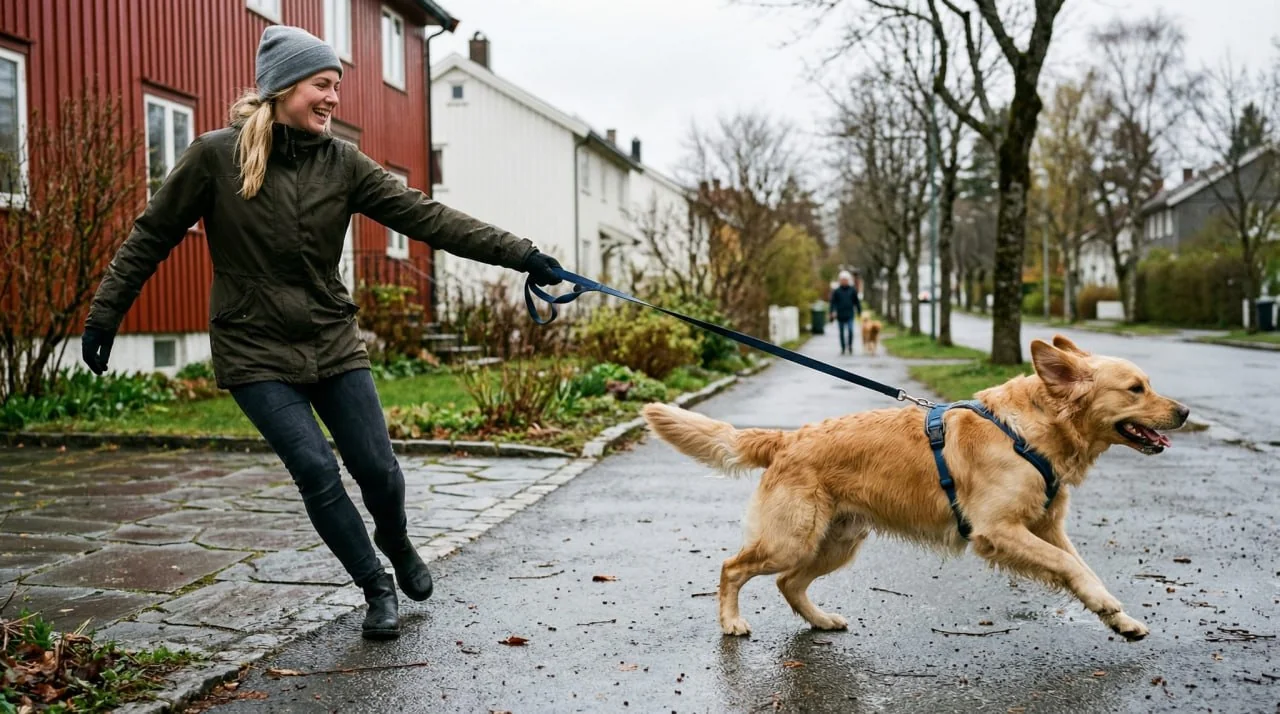
We have all been there. You stand outside the door looking forward to a quiet evening walk with your dog. Seconds later, you are being dragged down the street like a slalom cone on overdrive. Your arm burns. The dog is gasping and hyperventilating. The neighbour rolls their eyes. What should have been quality time together becomes a battle you never win.
But honestly? Most dog owners struggle with exactly this. We are talking about Norway's most common everyday dog challenge — a dog pulling on the lead as if its life depends on it. The difference between those who solve it and those who give up is not magic tricks or expensive aids. It is understanding why it happens and doing something about it on the dog's terms.
Wondering how to get your dog to walk nicely on a lead? This guide gives you more than five practical methods that actually work. You also get a realistic plan for going from chaos to your dream walk in eight weeks. Whether your dog is a puppy or has been pulling since Christmas Eve 2019.
Why does your dog pull on the lead?
From your dog's perspective: it works!
Imagine learning to drive simply by pressing the accelerator. Every time you accelerated, you got where you wanted to go. Would you not keep doing it?
That is exactly what your dog has learnt. She pulls because the strategy has produced results again and again. When she drags herself towards an interesting smell, the neighbour's dog, or simply further along the route, she learns that pulling pays off. This is not malice or dominance — it is just logic.
She has no idea that it hurts your arm or that you feel embarrassed when people stare. She only knows that pushing forwards brings forward progress. Simple as that.
The opposition reflex — the body works against you
Perhaps the cleverest thing your dog does is something she does not even think about. When you jerk back on the lead or hold firmly against her, you trigger what is called the opposition reflex. As dog expert Jean Donaldson explains in "The Culture Clash": the more you pull backwards, the more your dog pushes forwards.
It is like pushing a door marked "pull" — you achieve exactly the opposite of what you want. Your dog's instinct says that pressure in one direction means pushing back in the opposite direction. So the harder you try to stop her, the keener she becomes to move on.
Energy that needs an outlet
Many dogs pull simply because they have too much pent-up energy. If a dog has been at home all day and finally gets outside, it is like releasing a spring that has been compressed for eight hours. It explodes into action.
At other times, it is about overexcitement. Your dog sees lead training as the beginning of the world's greatest adventure. She loses all focus on you because everything around her is so much more exciting.
Pain you cannot see
In rarer cases, a sudden change in pulling behaviour can have a physical cause. If your dog normally walks reasonably well but suddenly starts pulling much more, it may be wise to check with a vet. Neck pain, shoulder problems or discomfort elsewhere can change how your dog moves.
When the equipment works against you
A lead that is too short (under 1.5 metres) creates constant pressure. A poorly fitted harness that rubs or restricts movement frustrates your dog. Retractable leads teach dogs that pulling gives more freedom. These things make your job ten times harder than it needs to be.
The right equipment for a dog that pulls on the lead
Harness or collar — what does the science say?
Let me dispel a myth straight away: "Harnesses make dogs pull more." This is outdated thinking contradicted by newer research. Carter and colleagues showed in 2020 that harnesses reduce pressure on the neck and throat by up to 60% compared with collars.
A Y-harness is recommended by virtually all modern dog trainers for a simple reason: it distributes pressure over the chest rather than squeezing the throat. Dogs pulling in collars can suffer injuries to the windpipe, cervical vertebrae and throat. With a harness, you can train safely while your dog learns.
The real reason dogs pull is poor training and inconsistency — not the type of harness. A dog that has learnt to pull will pull whatever it wears. A dog that has learnt to walk nicely will do so with either a harness or collar.
The right lead for a dog that pulls makes an enormous difference. A waterproof classic dog lead in the right length is the foundation of all lead training. The material must withstand daily use and every kind of weather, while being soft enough not to cause sores or discomfort.
Which lead length works best?
For structured training, I recommend a 1.5–2 metre fixed lead. No shorter (too little freedom for your dog) and no longer (you lose control). Never use a retractable lead during training — it teaches the wrong signal.
For ordinary walks, you can use 2.5–4 metres, depending on the environment. This lets your dog sniff and explore while you keep an overview.
For real freedom in open areas, a long training line of 5–10 metres is perfect. Your dog gets room to be a dog, while you retain control of the situation.
Hands-free training — free your hands
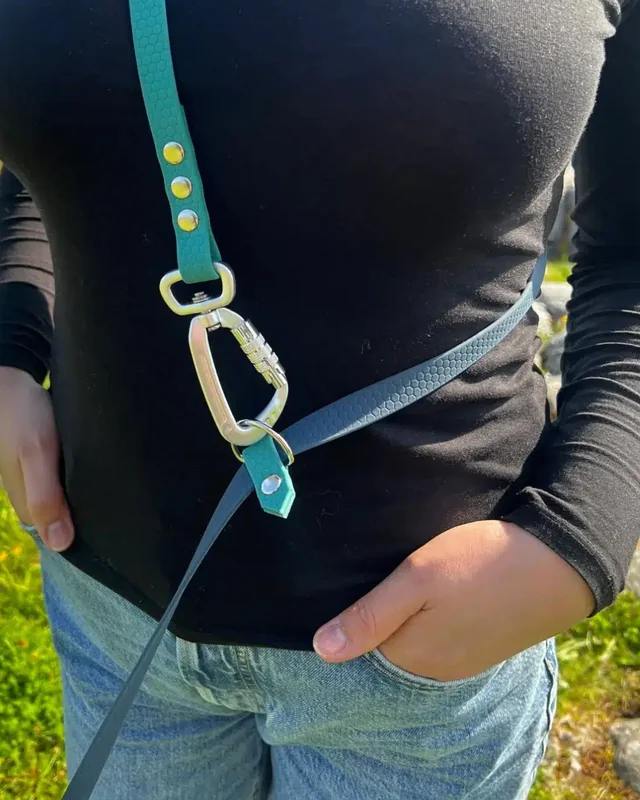
Many experienced trainers recommend a waist belt with a hands-free lead during training. When you do not have to think about where your hands are, you can focus completely on timing and rewards. A hands-free lead frees both hands to reward, direct and communicate with your dog.
An adjustable belt gives you comfort and control whatever your body size. Many people are surprised by how much easier training becomes when the equipment works for you rather than against you.
Equipment that sabotages training
Retractable leads are training's worst enemy. They teach the dog that pulling brings more freedom because the lead gives way. That is the exact opposite of what you are trying to teach.
Choke collars trigger the opposition reflex and can cause injuries. "Anti-pull" harnesses that squeeze under the armpits or restrict natural movement create discomfort and can cause behavioural problems.
Rule of thumb: if the equipment "stops" your dog through discomfort, it does not solve the problem. It only disguises it.
Our waterproof bestsellers — made for Norwegian weather

Dog leads
Hands-Free Dog Lead
from NOK 399.00
Hands-free dog lead in waterproof material, worn around the waist or over the shoulder. Available in 10 mm, 16 mm and 25 mm widths. Ideal as a running belt for jogging, hiking…
View product and customise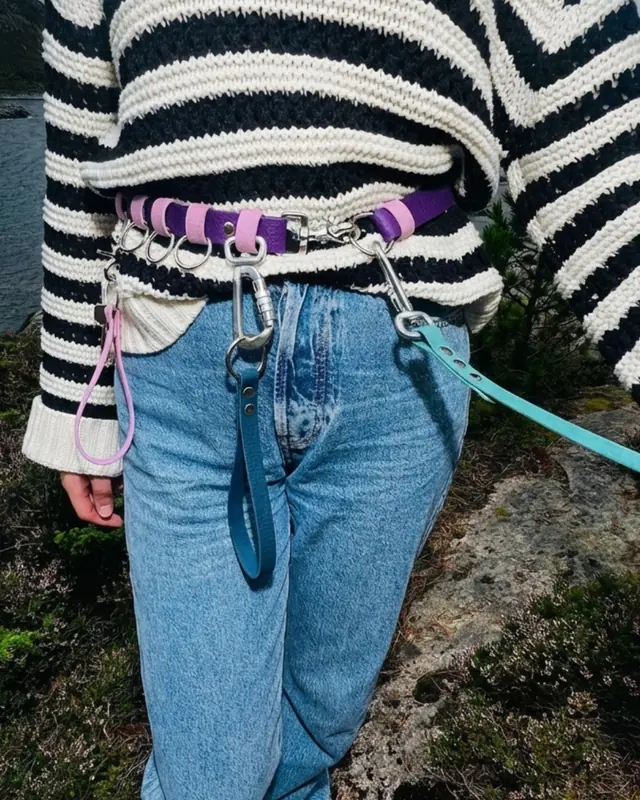

Belts
Adjustable Multifunctional Belt
from NOK 449.00
Adjustable dog walking belt in 16 mm or 25 mm waterproof webbing, designed for hands-free walks and dog sports. Fits sizes S to XL. Attach the lead to the belt and keep…
View product and customise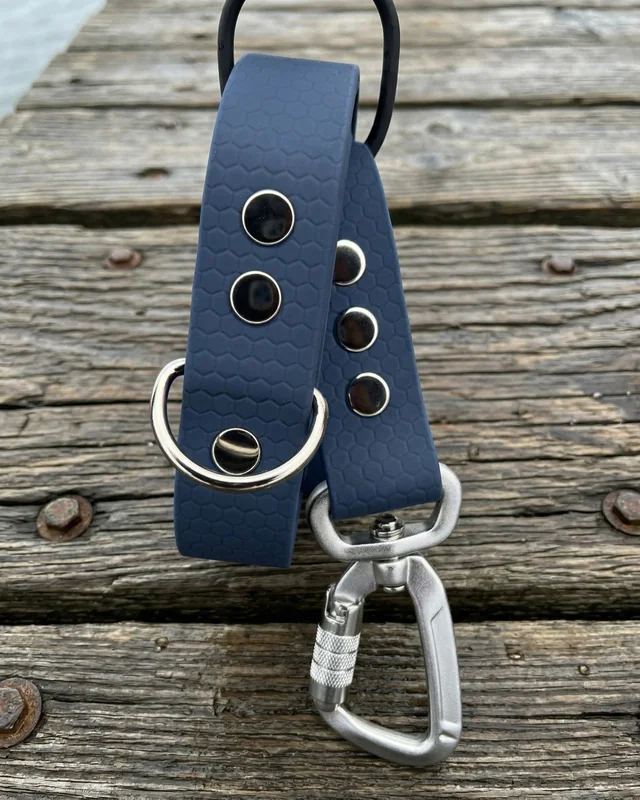

Dog leads
Classic Dog Lead
from NOK 329.00
Handmade dog lead in waterproof material with a honeycomb pattern for grip. Choose between three widths and lengths from 1.2 to 5 metres. Handles all kinds of weather, mud and…
View product and customiseHow to get your dog to walk nicely on a lead — 5 effective methods
Method 1: stop and wait — the basic rule
This is the cornerstone of all lead training. The rule is simple: when the lead tightens, all forward progress stops.
Here is how: the moment the lead tightens, stop. Say nothing. Do not jerk. Just stand completely still. Wait until your dog releases the pressure (she may look at you, take a step back, or simply stop pushing forwards). The second the lead becomes slack again, praise her and move on.
Your dog learns: tight lead = nothing happens. Slack lead = the world opens up.
Critical point: you must be consistent every single time. If you give in "just this once" because you are in a hurry, your dog learns that persistence pays. Then you have to start again.
Method 2: turn and walk — change direction when your dog takes over
When your dog passes you and starts pulling: turn 180 degrees without a word and walk in the opposite direction at normal speed. Do not jerk or drag. Just walk.
This teaches your dog that getting ahead of you does not lead to her goal. Quite the opposite — it takes her further away. She quickly learns that staying near you pays off.
Wait until she follows and the lead becomes slack. Then praise her, and you can continue towards the original goal.
Method 3: teaching heelwork with the right timing
This takes a little practice, but is incredibly effective once you get it right. Notice when your dog begins speeding up or staring at something interesting — before the lead tightens. Say "here" or "good" at exactly that moment.
If your dog responds and shifts her focus away from the distraction, reward immediately. If she ignores the cue and keeps pulling, ignore that and use the stopping method instead.
Pitfall: the cue must come before the lead is tight. Otherwise, your dog learns: pull → cue → reward.
Method 4: Grandma's law — reward with freedom
Ethologist Anna Bjurgård Compton recommends this method for dogs needing plenty of stimulation. The principle: one second of calm walking beside you earns ten seconds of freedom.
Once your dog has walked nicely for one second (or however briefly she can manage), say "free!" and let her run, sniff or investigate as a reward. After 10-30 seconds, call her back and repeat.
Gradually increase the time between "free" periods. Your dog learns that walking nicely gives access to what she loves most — freedom to be a dog.
Method 5: separate contexts — different equipment, different rules
Many professional trainers use this: one type of equipment means "free walk", where the dog can pull and explore. Another means "training time", where the dog must walk nicely.
For example: harness = you can pull. Collar = you must walk nicely. Or red lead = freedom, blue lead = structure.
Dogs learn this distinction surprisingly quickly. It gives you the flexibility to switch between relaxed walks and training sessions according to the situation.
Teaching an adult dog to walk nicely on a lead — is it possible?
Absolutely. Many people ask how to teach a dog to walk nicely on a lead once it is already an adult. Let me stop the myth here and now: it is never too late to teach an adult dog new habits. The problem is not the dog's age. It is that she has repeated the old pattern thousands of times.
The difference between a puppy and an adult dog
A puppy is like a blank sheet. She has no established habits or strong opinions about where she wants to go. Everything is new and exciting, so she is often willing to follow you anywhere for a treat.
An adult dog, however, has walked the same routes for months or years. She knows exactly where the best smell is, which corners need checking, and where the neighbour's dog usually is. She has also learnt that pulling works.
But her brain is just as adaptable as a puppy's. She can learn new patterns — it simply takes a little more patience from you.
How to adapt training for adult dogs
Start at home: practise basic commands and eye contact indoors before going outside. This builds the lines of communication between you.
Shorter sessions: how do you train a dog to walk nicely on a lead? With 3-5 minutes of intensive training, followed by a break. An adult dog that has pulled for years can become frustrated by overly long sessions.
High-value rewards: find what your dog loves most. Liver pâté, cooked chicken, cheese — that special thing she never normally gets. Use it as a reward for the first few weeks.
More patience: expect it to take longer. While a puppy may learn basic lead manners in two weeks, an adult dog may need six to eight weeks for the same progress.
How long does it actually take?
Realistic expectations based on experience with hundreds of dogs:
Weeks 1-2: your dog starts looking at you more often on walks. She still tests the boundaries, but you see moments of attention.
Weeks 3-4: short periods of slack lead. She can pass some distractions without pulling. Still inconsistent.
Weeks 5-6: can pass moderate distractions without pulling. Starts checking in with you before making decisions.
Weeks 7-8: consistently walks nicely in familiar areas. New places still need extra focus from you.
Special cases: pulling breeds such as Huskies and Malamutes may need 12-16 weeks because "pulling" is so deeply programmed in their genes. Small breeds are often quicker and may manage it in 2-4 weeks.
Signs that training is working
The first signs appear in attention, not pulling behaviour. Your dog starts looking at you more often. She checks in with you on walks. She responds faster when you speak to her.
When you see these signs, you are on the right track. The pulling changes afterwards.
Week-by-week training plan — from chaotic walks to dream walks
None of our competitors offers a practical plan you can follow. Here are eight weeks that take you from chaos to control:
Weeks 1-2: laying the foundations
At home (5 minutes daily):
- Practise eye contact. Hold a treat beside your face and praise your dog when she looks at you.
- Let your dog get used to the training equipment. Let her sniff the harness and receive treats.
- Keep the lead loose indoors and reward simply being near you.
Outside (5 minutes per walk):
- Choose the most boring place you can find. Aim: zero distractions.
- Practise only the stop-and-wait method. Nothing else.
- Always finish on a good note. Three successful minutes are better than ten frustrating ones.
Weeks 3-4: building on success
Longer sessions (10 minutes of training per walk):
- Continue using stop and wait as the main method.
- Introduce the "here" command when your dog looks at you. Say it only when she actually looks at you.
- Reward every single time the lead is slack. Exaggerated praise. She should associate a slack lead with the world becoming wonderful.
New environments:
- Move to slightly more interesting places. Still not the hardest ones.
- Practise outside shops or in parks, but at a safe distance from the activity.
Weeks 5-6: gradually increasing the difficulty
Distractions:
- Practise with other dogs present at a safe distance (30+ metres to begin with).
- Walk past interesting smells on the pavement.
- Introduce the turn-and-walk method for stronger pulling.
Longer sessions:
- 15-20 minutes of training per walk.
- Combine several methods in the same session.
- Begin reducing the number of rewards very gradually.
Weeks 7-8: consolidating and expanding the skills
Variety:
- Practise in different environments. Your dog needs to generalise the learning.
- Train on both sides of your body (right and left).
- Test more challenging situations.
Testing independence:
- Can your dog walk nicely for five minutes without a reward?
- Does it work when you meet people you know on a walk?
- Can she manage in new areas she has never visited?
If the answer to these is yes, you have reached your goal.
Common mistakes that keep your dog pulling
You let your dog "win" occasionally
This is by far the biggest mistake dog owners make. You train well from Monday to Thursday. On Friday, you are in a hurry and let the dog pull you to the shop "just this once".
From your dog's perspective, she learns: if I persist long enough, I get what I want. It is like a slot machine that pays out occasionally — it only makes her more motivated to continue.
You jerk the lead when your dog pulls
This triggers the opposition reflex. Your dog pulls back when she feels a forward jerk. You achieve exactly the opposite of what you want. Jerking also creates negative associations with you and with the whole walking experience.
You say "walk nicely" when your dog is pulling
This creates the wrong association. Your dog learns: when I pull, mum/dad says "walk nicely". She thinks the command means "pull right now". Give commands only when your dog is actually doing the right thing.
You expect too much, too soon
Many owners want perfect results in seven days. That is like expecting a child to read Harry Potter after a week learning the alphabet. Realistic expectations: noticeable improvement after four weeks, solid improvement after eight weeks.
You use the wrong equipment
Using a retractable lead during training is like learning to drive in a car without brakes. Overly short leads (under 1.5 metres) create constant pressure. Poorly fitted harnesses make your dog uncomfortable and frustrated.
The family does not follow the same rules
Dad uses the stopping method. Mum lets the dog pull. The children get dragged around. Your dog receives conflicting signals and learns that the rules depend on who holds the lead.
You reward at the wrong moment
Timing is critical. If you give a treat three seconds after your dog stops pulling, you reward whatever she did just before the treat — not what you think you are rewarding.
You give up just before the breakthrough
Many owners give up in week four or five when things feel hopeless. Ironically, that is often when the dog is on the verge of understanding. The final weeks are where the magic happens.
When should you seek professional help?
Red flags — call a dog trainer if:
Your dog shows aggression towards other dogs or people when the lead is tight. This may indicate frustration or fear-based aggression needing expert treatment.
Your dog panics or becomes extremely stressed on walks. If she shakes, hyperventilates or shows other signs of extreme anxiety, the problem goes deeper than pulling behaviour alone.
No progress after eight weeks of consistent training. There may be medical causes, or your dog needs a more tailored training plan.
Your dog injures you by jerking or pulling. Large dogs can cause shoulder problems, cuts to your hands or falls.
You are unsure about your technique or concerned about your dog's behaviour. Better to ask once too often than do it wrong for months.
Where to find help
The Norwegian Kennel Club has a directory of approved dog trainers throughout the country. They can refer you to someone specialising in everyday training.
Behaviour consultants have more in-depth expertise in complex behavioural challenges. Some vets have specialist behavioural training and can rule out medical causes.
Canis.no (Turid Rugaas and an expert panel) has self-help training resources and can recommend local contacts.
AniCura and other veterinary clinics can check for physical causes of changed behaviour and refer you to the right professional.
Frequently asked questions
Why does my dog pull on the lead even though we train?
The most common causes are inconsistency (the dog is allowed to pull sometimes), progressing to difficult environments too soon, or giving cues at the wrong moment. Make sure everyone in the family follows the same rules, and reward the moment the lead becomes slack — not three seconds afterwards.
Is a harness better than a collar for a dog that pulls?
Yes, a Y-harness is generally better and safer. It distributes pressure across the chest rather than the throat, reducing the risk of injury to the windpipe and cervical vertebrae. Research shows that the myth "harnesses make dogs pull more" is untrue — poor training makes dogs pull, not the harness type.
Can an adult dog learn to walk nicely on a lead?
Definitely! It simply takes a little longer than with puppies. Expect 4-8 weeks of daily training for noticeable improvement. Adult dogs have established habits that need to be "overwritten", but they are certainly capable of learning new behaviour patterns. The key is patience, consistency and rewards your dog really cares about.
Do retractable leads help with pulling?
No, retractable leads usually make the problem worse. They teach the dog that pulling brings more freedom, the exact opposite of what you want. Retractable leads can also be dangerous — they can cause friction burns, wrap around legs, or be pulled from your hand. Use a 1.5-2 metre fixed lead for all training.
How long should the lead be?
For training: a 1.5-2 metre fixed lead gives you control without making your dog feel confined. For ordinary walks: 2.5-4 metres lets your dog sniff and explore safely. For freedom in open areas: a 5-10 metre long line provides room to move with control. Never under one metre — that creates constant pressure.
Should I use treats during training?
Absolutely! High-value rewards are essential, especially initially. Use what your dog loves most — cooked chicken, liver pâté or special dog food she never normally gets. Gradually reduce the amount as the behaviour becomes established, but do not stop abruptly. The transition should take several weeks.
What should I do when my dog pulls towards another dog?
Stop before the lead tightens and wait until your dog looks at you. Praise and reward the eye contact, then walk in an arc around the other dog. Begin at a large distance (30+ metres) and gradually reduce it over several weeks. Do not let your dog learn that pulling towards other dogs earns a greeting as a reward.
How long should I train on each walk?
Start with 5 minutes of intensive training per walk in the first few weeks. Gradually increase to 10-15 minutes after a month. Remember that mental stimulation is tiring — shorter, high-quality sessions with plenty of success are better than long, frustrating tug-of-wars. Always end with a positive experience.
Conclusion
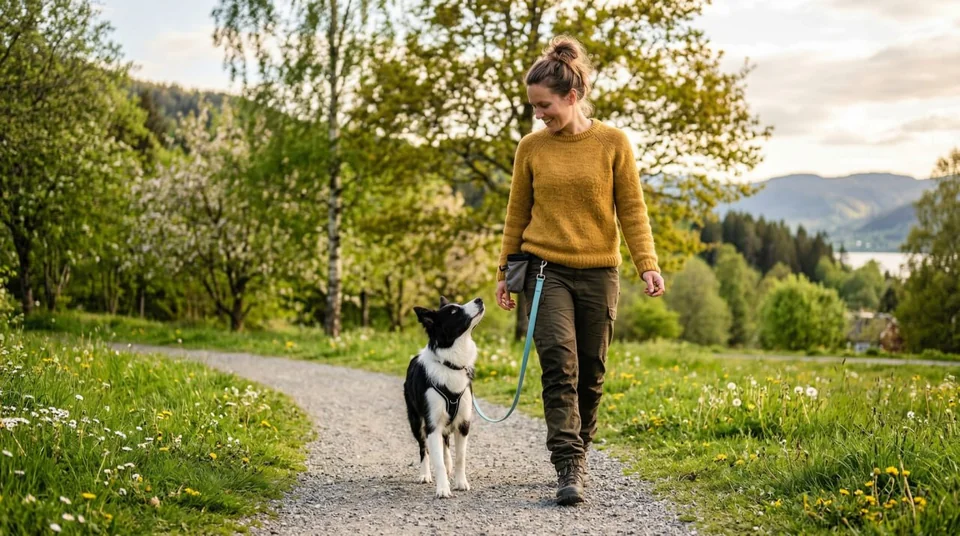
Teaching your dog to walk nicely on a lead is not about creating a robot marching beside you. It is about building a line of communication in which your dog understands that cooperating with you brings better results than fighting against you.
Most dogs that pull are not trying to be difficult. They do it because it has worked before, and because nobody has taught them there is a better way.
With the right equipment, realistic expectations and consistent methods, you and your dog can go from frustrating tug-of-wars to enjoyable walks together. It takes time — usually 4-8 weeks — but the investment is worth it every time.
The key is remembering that this is a marathon, not a sprint. Your dog learns something new in every session, even if it is not always visible on the surface. Be patient with her and kind to yourself throughout the process.
When you finally stand there with a slack lead and a dog checking in with you on a walk, you will realise it is about something much bigger than lead manners alone. It is about trust, communication and respect between two species that have chosen to share their lives.