Guides
Dog collars — a complete guide for dog owners (2026)

Choosing the right dog collar is something most dog owners do not think about very much — until the collar breaks in the middle of a walk, or the dog slips out of it at a critical moment. I have had dogs for more than fifteen years, and I can tell you: a good dog collar is just as important as a good lead. Perhaps more important. After all, it holds the ID tag, it is what you grab when your dog decides to greet the neighbour a little too enthusiastically, and it tells the world that “this dog has a human”.
In this guide, we will cover everything you need to know about dog collars — from different types and materials to choosing the right size and what to do when your puppy grows like a weed. Whether you are a new dog owner or have had furry companions all your life, I promise you will find something useful here. And yes, we will also discuss the eternal question: collar or harness?
Let us get started.
Contents
- Types of dog collar
- Materials — what is the collar made of?
- How to choose the right collar
- Collars for large dogs
- Collar vs harness — when should you use each?
- Maintenance and cleaning
- Our collars at ÅlesHund
- Frequently asked questions

Types of dog collar — an overview
Whether you search for the Norwegian terms “halsbånd hund” or “halsband hund”, there is a sea of options out there, and it can quickly feel overwhelming. But it really comes down to a few main types. Let me explain each one, with its advantages, disadvantages and who it suits.
Buckle collar (traditional)
The classic dog collar with a metal buckle — a little like your own belt, just in a dog version. Put the prong through a hole, and the collar is fastened. Simple and straightforward.
Advantages:
- Tried and trusted — this has worked for hundreds of years
- Fits securely without slipping
- Easy to adjust
- Looks classic and stylish
Disadvantages:
- Takes a little longer to put on and remove than a clip
- The hole system offers fewer adjustment options than continuous adjustment
Suitable for: Most dogs, especially those that wear their collar all day. Perfect if you value durability and a traditional look. We have a waterproof buckle collar that combines the classic feel with modern materials.
Clip collar (quick-release clip)
This uses a plastic or metal clip instead of a buckle. Click — on. Click — off. Done.
Advantages:
- Quick to put on and remove — perfect for impatient dogs (and owners)
- Often continuously adjustable with a sliding buckle
- Practical if you frequently switch between collar and harness
Disadvantages:
- Plastic clips can break over time, especially on cheap models
- Some strong dogs can force cheap clips apart
Suitable for: Everyday use, growing puppies (easy adjustment), and dogs whose collars are frequently put on and taken off. Explore our clip collar — made with industrial clips that can take a knock.
Half-check / martingale
A half-check collar is a clever middle ground. It normally sits loosely and comfortably, but tightens gently when the dog pulls — without tightening fully like a choke collar. Think of it as a collar with built-in security.
Perhaps you have seen one at dog shows? A half-check show lead is actually the most widely used choice in the show ring, because it provides control without disturbing the dog's posture.
Advantages:
- The dog cannot back out of it (perfect for narrow-necked breeds such as Greyhounds and Whippets)
- Gentler than a choke collar — controlled tightening
- Popular as a show lead
Disadvantages:
- Not ideal as a permanent collar (should be removed when unsupervised)
- Can catch on things when the dog plays freely
Suitable for: Dogs that easily slip out of ordinary collars, show dogs and dogs in training. Half-check dog collars are particularly popular with owners of sighthounds and other narrow-headed breeds.
Collars with GPS or an ID tag
In 2026, smart collars are available with built-in GPS, activity tracking and even health monitoring. Some have space for AirTags or Tile tags. These are particularly relevant now that Norway's compulsory lead rules require you to keep control of your dog during certain periods.
Advantages:
- You can track your dog in real time
- Some models have D-rings for attaching an ID tag and GPS unit
- Provides reassurance, especially for dogs that run away
Disadvantages:
- Expensive
- Needs charging
- The GPS unit can be bulky
Tip: You do not need a specialist collar for GPS. An ordinary sturdy collar with D-rings works well with an AirTag holder.
Collars with a name — personal and practical
A dog collar with a name has become enormously popular in recent years, and it is easy to see why. Instead of a dangling ID tag that makes a noise, your dog's name and your telephone number are engraved or embroidered directly onto the collar.
A personalised dog collar has several advantages:
- No tag to fall off — the information stays permanently on the collar
- Less noise — no jangling D-rings and tags
- Looks stylish — a personalised engraved dog collar looks truly premium
- Practical for safety — if your dog escapes, whoever finds it can call you directly
You can find named dog collars in many versions — from embroidered text to metal letters. Some people choose only the dog's name, while others opt for a dog collar with a name and telephone number, which is what I recommend. What use is it for people to know the dog is called Bella if they cannot call you?
A personalised dog collar also makes a lovely gift for a new dog owner. Personal, practical, and something they will actually use — unlike their fifth dog book.
Materials — what is the collar made of?
The material may be the most important choice you make. An attractive dog collar might look good in the shop, but if it falls apart after three months of rain and mud, it is money wasted. Let us look at the most common materials.
Nylon
Nylon is by far the most common material for dog collars, and it is easy to see why: it is cheap, comes in every colour under the sun, and is quite strong.
But — and this is a big but — nylon absorbs water like a sponge. After a walk in the rain or a dip in the water, you have a wet, heavy collar that takes forever to dry. And that smell? You know the one I mean. The combination of wet dog and damp nylon is something else.
Nylon also wears quite quickly. After a few months of daily use, the edges start to fray and the colour fades. Fine as a first collar, but not something you keep for years.
Leather and hide
Ah, leather dog collars — the classic, timeless choice. A good leather collar for a dog is something special. It looks fantastic, moulds to the dog's neck over time, and can last for many, many years.
Advantages of leather collars:
- Durable and hard-wearing
- Looks better with time (patina)
- Soft and comfortable
- A classic appearance that never goes out of fashion
Disadvantages of leather dog collars:
- Does not withstand water well — leather stiffens and can crack
- Needs maintenance (leather conditioner/balm)
- Can smell when wet
- More expensive than nylon
- Not everyone is comfortable with animal hide
If you live somewhere where it rarely rains (in other words, not Norway), a leather collar is an excellent choice. But let us be honest — we live in Norway. It rains. A lot. And that means leather may not be the smartest material for something used outdoors in every kind of weather.
Waterproof material — our choice
This brings us to what we are passionate about at ÅlesHund. Waterproof webbing is a modern material that combines the best of all worlds. The collar is made from a waterproof, durable material that absorbs neither water, smells nor dirt.
Why we love waterproof material:
- Waterproof and durable — withstands everything Norwegian weather can throw at it
- Easy to clean — simply wipe with a cloth or rinse under the tap
- No smell — no bacterial growth, no “wet dog” smell
- Holds its colour — UV-resistant, does not fade
- Soft as leather — moulds to your dog's neck
- Vegan — no animals involved
Imagine coming home from a three-hour mountain walk in rain and mud. Your dog has rolled in something unidentifiable. With a nylon collar, you now have something that smells like the bottom of a rubbish skip. With a leather collar, you have something that needs careful drying and leather conditioner. With waterproof webbing? Rinse it under the tap for ten seconds, and it is like new. Done.
That is why all our products at ÅlesHund use this material — including our buckle collars and clip collars.
Textiles and fabric
Collars in cotton, hemp or other fabrics are soft and comfortable, but share many of nylon's drawbacks: they absorb water, can smell, and wear relatively quickly. They are lovely as fashion accessories, but not the best choice for long walks in the Norwegian outdoors.
Material comparison
| Property | Nylon | Leather/hide | Waterproof material | Textile/fabric |
|---|---|---|---|---|
| Waterproof | ❌ No | ❌ No | ✅ Yes | ❌ No |
| Smell | Yes, after use | Can occur | No | Yes, after use |
| Durability | Medium | High (with maintenance) | Very high | Low–medium |
| Maintenance | Wash/dry | Leather conditioner + care | Wipe / rinse | Wash/dry |
| Comfort | Good | Excellent (broken in) | Excellent | Good |
| Appearance | OK | Premium | Premium | Varies |
| Price | 💰 | 💰💰💰 | 💰💰 | 💰–💰💰 |
| Suitable for Norwegian weather | Medium | Poor | Perfect | Poor |
As you can see, waterproof material is the winner for Norwegian conditions. That does not mean leather is bad — a leather dog collar is wonderful for indoor use or fine weather. But for an all-round collar that withstands everything, waterproof is the way to go.
How to choose the right collar
Now you know which types and materials are available — whether you searched for “halsband hund” or “halsbånd”, it is now about finding the right size. Your dog can slip out of a collar that is too large, while one that is too small pinches and feels uncomfortable. Here is a practical guide.
Puppy collars — start right from day one
Finding a puppy collar can feel like aiming at a moving target — because puppies grow so fast! A Golden Retriever puppy can go from a 30 cm neck circumference to 55 cm in a few months.
My tips for puppy dog collars:
- Start narrow — a puppy does not need a 25 mm collar. Start with a 10 mm or 16 mm width.
- Choose adjustable — a continuously adjustable collar (typically clip models) gives you more flexibility.
- Do not spend too much — your puppy will outgrow it. Have an affordable puppy collar and upgrade once the dog has finished growing.
- Get your dog used to it — let your puppy wear the collar indoors first, without a lead. Some puppies find it a little strange initially.
- Use the “two-finger rule” — you should be able to place two fingers between the collar and your dog's neck.
Remember: a puppy should never be left unsupervised wearing a collar, particularly in a crate or enclosure where it can catch.
Collars for large dogs
If you have a large dog — say a Labrador, German Shepherd, Bernese Mountain Dog or Rottweiler — you need a large-dog collar that withstands the forces involved. Here, 25 mm is a minimum width, and the material must be sturdy.
For large dogs, I always recommend buckle collars over clips. A metal buckle is simply stronger than even good plastic clips when a 40 kg dog decides that squirrel MUST be chased. Our waterproof buckle collar in a 25 mm width withstands up to 250 kg of pulling force — more than enough even for the most enthusiastic pullers.
How to measure your dog's neck
Measuring correctly is essential. Do this:
- Use a soft tape measure (the dressmaking type)
- Measure around your dog's neck where the collar normally sits — usually mid-neck
- Place two fingers between the tape measure and your dog's neck
- Read the measurement — this is your neck size
No tape measure? Use a piece of string, mark it, and measure the string with an ordinary ruler.
Important: Always measure when your dog is calm. Some dogs “puff up” when excited, giving you the wrong measurement. And remember that fur takes up space — a long-haired dog often needs a little extra.
Which width suits my dog?
The collar width should suit your dog's size. A collar that is too narrow on a large dog creates too much pressure per square centimetre, while an overly wide collar on a small dog is bulky and uncomfortable.
Here is a general guide:
| Width | Suitable for | Breed examples |
|---|---|---|
| 10 mm | Small dogs and puppies | Chihuahua, Yorkshire Terrier, Papillon, Miniature Pinscher, puppies of medium-sized breeds |
| 16 mm | Medium-sized dogs | Beagle, Cocker Spaniel, Border Collie, Shetland Sheepdog, Shiba Inu |
| 20 mm | Medium-sized to large dogs | Labrador, Golden Retriever, Dalmatian, Boxer, Springer Spaniel |
| 25 mm | Large, strong dogs | German Shepherd, Rottweiler, Bernese Mountain Dog, Leonberger, Great Dane |
Our waterproof bestsellers — made for Norwegian weather

Dog leads
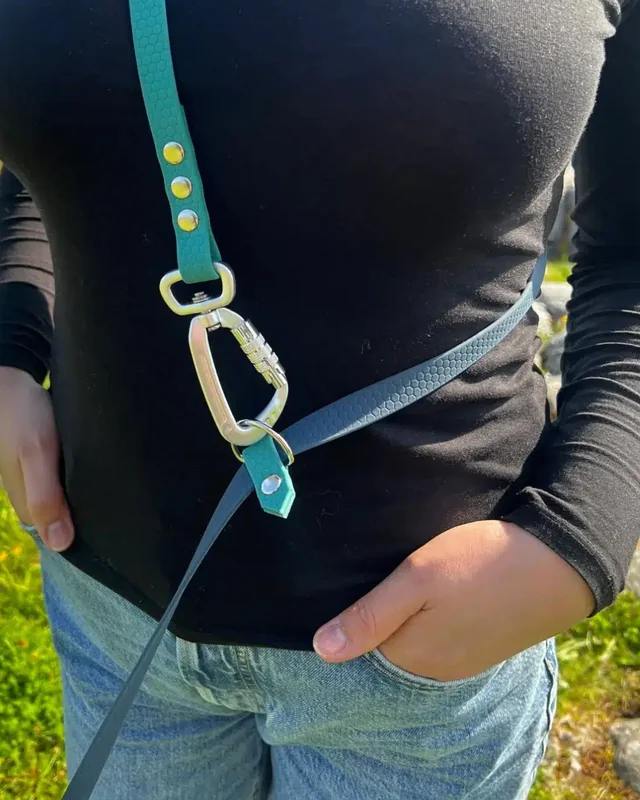
Hands-Free Dog Lead
from NOK 399.00
Hands-free dog lead in waterproof material, worn around the waist or over the shoulder. Available in 10 mm, 16 mm and 25 mm widths. Ideal as a running belt for jogging, hiking…
View product and customise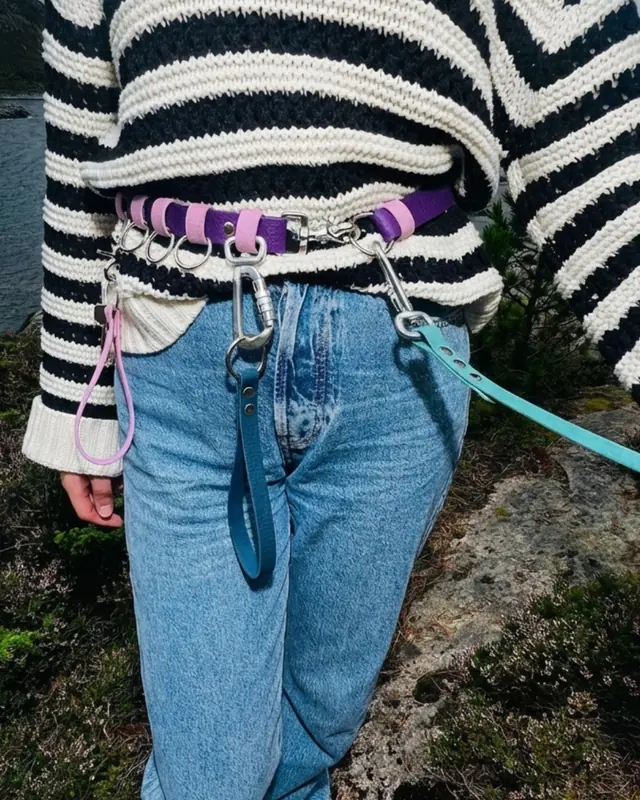

Belts
Adjustable Multifunctional Belt
from NOK 449.00
Adjustable dog walking belt in 16 mm or 25 mm waterproof webbing, designed for hands-free walks and dog sports. Fits sizes S to XL. Attach the lead to the belt and keep…
View product and customise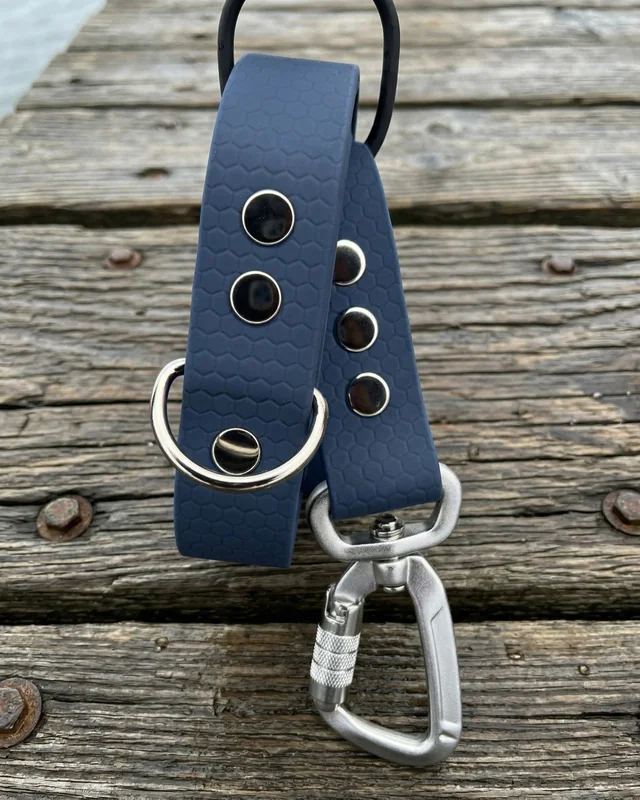

Dog leads
Classic Dog Lead
from NOK 329.00
Handmade dog lead in waterproof material with a honeycomb pattern for grip. Choose between three widths and lengths from 1.2 to 5 metres. Handles all kinds of weather, mud and…
View product and customiseCollars for large dogs — what do German Shepherds, Labradors and Bernese Mountain Dogs need?
A collar for a Chihuahua can certainly be attractive. A collar for a 35 kg German Shepherd needs to look good and withstand 200 kilos of pulling force when a cat surprises the dog. That is the difference we are talking about here.
If you have a large or powerful dog — a German Shepherd, Labrador, Bernese Mountain Dog, Golden Retriever, Rottweiler, Malinois or a crossbreed in the same category — there are some things you cannot compromise on when choosing a collar. We have made handmade collars for large dogs for several years, and here is what we recommend.
Width — under 25 mm is too narrow
Narrow collars dig into a large dog's neck when it pulls. That is physics, not aesthetics. For dogs over 20 kg, we recommend a minimum width of 25 mm. For dogs over 35 kg, you can comfortably move up to 30–40 mm. The wider the collar, the better it distributes pressure — and the more comfortable it sits around the neck.
The material must withstand daily pulling
Many traditional leather collars look lovely in the shop, but crack after one Norwegian winter season of slush and salt. For large dogs, we recommend waterproof webbing that does not absorb water, does not rust, and withstands rain, mud and seawater. The webbing we use has a breaking strength of several hundred kilos — far beyond what even a powerful dog can produce.
Snap hook and D-ring — weak links decide
A collar is never stronger than its weakest fitting. For large dogs, the D-ring should be solid brass or stainless steel, and the snap hook on the lead you attach should have a screw lock or double mechanism. Plastic buckles and thin metal rings are fine for a Spaniel — not a Rottweiler.
Half-check — the smart choice for dogs that pull
A half-check collar (also called a limited-slip collar) tightens a little when the dog pulls, but never chokes. It prevents the collar slipping over the head and gives a gentle correction without injury. For large dogs that easily pull free from an ordinary collar, a half-check is often the safest solution. We make half-check models to order.
Weight and comfort — heavier is not always better
It is a myth that large dogs need heavy collars. A good collar for a German Shepherd rarely weighs more than 150–200 grams. Heavier collars irritate the coat and offer no extra security — the strength is in the material and hardware, not the weight.
How to measure large dogs
Measure around the neck where the collar will sit — not too high, nor down by the shoulders. You should be able to fit two fingers between collar and neck. Typical measurements for large breeds:
- Labrador, Golden Retriever: 45–55 cm neck measurement, 25–30 mm width
- German Shepherd, Malinois: 50–60 cm, 30 mm width
- Bernese Mountain Dog, Rottweiler: 55–65 cm, 30–40 mm width
- Newfoundland, Leonberger: 60–70 cm, 40 mm width
If you need a collar tailored specifically to your large dog, we make it to order in Ålesund — with your choice of measurement, colour and hardware.
Rule of thumb: If you are unsure between two widths, choose the narrower one for comfort — but only with a sturdy material. Waterproof webbing in 16 mm is surprisingly strong, and many medium-sized dogs are comfortable with it.
Collar vs harness — when should you use each?
The big question. And the answer is (as so often with dogs): it depends.
Let me break it down:
When a collar is best
- A well-trained dog that walks nicely on the lead — no reason for a harness if the dog does not pull
- ID and daily use — the collar with an ID tag (or engraved name) should always be on
- Quick walks — much easier to clip a lead onto a collar than put on a harness
- Dog shows — collars are used here (often half-checks)
When a harness is best
- Dogs that pull a lot — a harness spreads pressure across the chest rather than the neck
- Brachycephalic breeds (Pugs, Bulldogs, etc.) — these have narrow airways and should never have pressure on their neck
- Puppies in training — combine a harness for walks with a collar for ID
- Dogs with neck or back problems
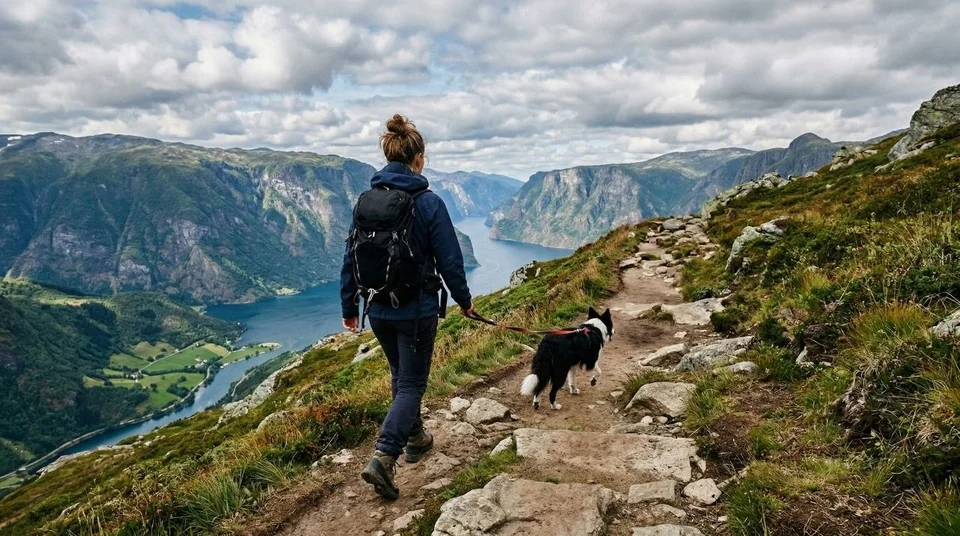
- Long walks and mountain hikes — a harness gives more comfort over time
My recommendation
Use both. Let your dog wear a collar with an ID tag (or name) at all times, and use a harness for the walk itself if your dog pulls or needs one. Attach the lead to the harness, not the collar — then you have the best of both worlds.
Speaking of leads — we have a complete guide to choosing the right dog-lead length, and another on snap hooks and attachment mechanisms. Worth reading alongside this article!
Maintenance and cleaning
A collar that is not maintained quickly becomes unpleasant — and can actually become a health hazard for your dog (bacteria, fungi, irritation). Here is how to keep the different materials in good condition.
Nylon
- Wash in lukewarm water with mild soap
- Can be machine-washed (put it in a mesh laundry bag)
- Dry thoroughly — nylon that stays damp starts to smell
- Replace when the edges fray
Leather/hide
- Wipe with a damp cloth
- Use leather conditioner or balm 2-4 times a year
- Never leave it wet — dry immediately
- Store somewhere dry between uses
- Avoid immersing it in water
Waterproof material
- Wipe with a damp cloth — done
- For a thorough clean: rinse under running water
- Extra dirty? Use a little washing-up liquid
- Dries in seconds
- Needs no special treatment
- Looks like new even after months of daily use
See the pattern? Waterproof material is by far the easiest to maintain. It is easy to clean, needs no special treatment, and stays looking good for years. Perfect for lazy dog owners like us who have enough to do keeping track of our furry friends.
Our collars at ÅlesHund
Right, you have now read through materials, types and sizing guidance. Let me tell you a little about what we offer — not because I want to nag you about our products, but because I honestly believe we have made something good.
All ÅlesHund collars are handmade in Norway from waterproof webbing. The collar uses waterproof, durable material, and we use quality stainless-steel hardware. No plastic clips that break, no cheap D-rings that bend.
Buckle Collar
Our classic collar with a traditional buckle. Available in several colours and widths (16 mm and 25 mm). Perfect for everyday use, with D-rings for an ID tag and lead. Free delivery on orders over NOK 1099.
Clip Collar
For those who want quick and easy. An industrial clip in metal or strong plastic, continuous adjustment, and of course the same waterproof material. A popular choice for attractive dog collars that can take a knock.
Does the collar go with a waterproof dog lead? Absolutely — and they come in matching colours. It simply looks rather stylish.
Frequently asked questions about dog collars
Collar or harness for a puppy?
For puppies, most trainers recommend a harness for walks and a collar for ID. Puppies have soft, developing neck structures, and a collar under heavy pulling can injure them. Let your puppy wear a light puppy collar with an ID tag at all times, but attach the lead to the harness. Once your dog is well trained and fully grown, a collar can also be used for walks.
How tight should the collar be?
Use the two-finger rule: you should be able to place two fingers flat between the collar and your dog's neck. If you can fit your whole hand in, it is too loose — the dog could slip out. If you can barely fit one finger, it is too tight and may cause irritation, hair loss or breathing difficulties. Check regularly, especially with growing puppies.
Can a dog wear a collar all the time?
A dog can wear a flat buckle or clip collar most of the time, but remove it at night and when the dog is alone in a crate or enclosure. Collars can catch on things, which can be dangerous in the worst case. Half-check collars should always be removed when the dog is unsupervised, as the loop mechanism poses a choking risk.
What is a half-check collar?
A half-check (also called a martingale) is a collar that tightens in a controlled way when the dog pulls, but never tightens fully like a choke collar. It consists of two loops — a main loop and a control loop. Half-checks are widely used as show leads and are ideal for narrow-headed dogs that can easily slip out of ordinary collars, such as Greyhounds, Whippets and Italian Greyhounds.
Is a collar with a name necessary?
Not necessary, but very practical. In Norway, dogs are legally required to be ID-marked (chipped), but a dog collar with a name and telephone number makes it much easier for people to contact you if your dog escapes. A microchip needs a reader — a visible name and number on the collar can save the day. Many dog owners use it in addition to a chip.
Which width suits my dog?
A general rule of thumb: 10 mm for small dogs and puppies (under 5 kg), 16 mm for medium-sized dogs (5–25 kg), 20 mm for medium-sized to large dogs (20–35 kg), and 25 mm for large, strong dogs (over 30 kg). If in doubt, narrower is often more comfortable, provided the material is strong enough. See our sizing table earlier in the article for breed examples.
How do I measure my dog's neck?
Use a soft tape measure around your dog's neck where the collar normally sits — usually mid-neck. Hold two fingers between the tape and neck, then read the measurement. If you do not have a tape measure, use string and measure it with a ruler afterwards. Always measure when your dog is relaxed, not excited or stressed, as some dogs tense their neck muscles.
Is leather or waterproof material best?
It depends on how you use it. Leather looks classic and develops a lovely patina, but does not handle moisture well and needs regular maintenance. Waterproof material is waterproof and durable, does not smell, and needs no maintenance — perfect for Norwegian conditions with plenty of rain and changeable weather. For everyday all-round use in Norway, we recommend waterproof. For special occasions or indoor use, leather is a lovely alternative.
How often should I replace a collar?
Check the collar regularly for wear. Replace it immediately if you see fraying material, loose seams or damaged hardware. A nylon collar typically lasts 6–12 months, leather 2–5 years (with maintenance), and waterproof material 3–7+ years. Also check that the size is still right — dogs can gain weight, lose weight or grow.
Can I use a collar for training?
An ordinary flat collar can be used for basic obedience training where the dog does not pull much. For dogs that pull, a harness is better to avoid injury. A half-check can be used for controlled training, but should only be used by experienced owners or under a trainer's guidance. Avoid choke chains and prong collars — they can injure your dog and are often unnecessary with the right training technique.
Summary
A good dog collar is an investment in your dog's safety and comfort. This guide has covered everything from different types of dog collar (buckle, clip, half-check, personalised) to materials (nylon, leather, waterproof, textile), sizing for puppies through to large dogs, and maintenance.
Here are the key takeaways:
- The material matters most — waterproof material is superior, particularly in the Norwegian climate
- Measure correctly — the two-finger rule is your friend
- Width according to size — 10 mm for small, 16 mm for medium, 25 mm for large
- Collar + harness — feel free to use both, with the lead attached to the harness
- Maintenance — keep the collar clean for your dog's health
- ID — consider a named collar in addition to a chip
Have questions about choosing a collar, or anything else about dog equipment? Please get in touch — we are dog enthusiasts who love to help! And explore our collars and the rest of the range at ÅlesHund. We offer free delivery on orders over NOK 1099, and everything is handmade from waterproof material that withstands Norwegian conditions.
Enjoy your walk with the dog! 🐕