Guides
Puppy collars — a complete guide for new dog owners

Updated April 2026 · Reading time: approx. 10 minutes
You have brought your puppy home, made a bed from an old woolly jumper and ordered half the pet shop's range online. Then comes the question many new dog owners do not think about until they are standing in the shop: which collar is suitable for a puppy?
It is not a trivial question. A collar that is too big slips off. One that is too tight gets caught and can injure a growing neck. The wrong material causes irritation. The wrong type can make it harder to teach your puppy to walk calmly on a lead.
In this guide, we cover everything you need to know about puppy collars — from the first week at home to the move to an adult collar. We look at sizing, materials, getting used to wearing one and the most common mistakes new dog owners make.
- When should a puppy start wearing a collar?
- What makes a good puppy collar?
- The right size — how to measure your puppy's neck
- Materials: what is best for sensitive puppy necks?
- Collar versus harness for a puppy — what is recommended?
- How to get your puppy used to a collar
- How to adjust the collar as your puppy grows
- Common mistakes new dog owners make
- When should you switch to an adult collar?
- Frequently asked questions

When should a puppy start wearing a collar?
Most vets and dog trainers recommend introducing a collar from 8 weeks of age — around the time your puppy first comes home with you. There is no reason to wait.
In fact, the opposite is true: the earlier your puppy gets used to having something around its neck, the easier the transition to a lead. A puppy that has never worn a collar and suddenly gets one at 6 months old may react with anything from mild confusion to actively fighting against the lead.
There is one important exception: puppies under 8 weeks should not wear a collar. During this period, their skin is particularly sensitive, and they are not ready for this type of stimulation.
Another point to remember: during the first weeks at home, the collar does not need to stay on all the time. Start with short periods — 15 to 30 minutes — while you are there and can check that everything is all right. Then gradually increase the time.
What makes a good puppy collar?
A good puppy collar has a few specific qualities that distinguish it from an ordinary adult collar:
- Lightweight — your puppy should barely notice it is wearing anything, rather than carrying a burden. Lightness matters most at the beginning.
- Adjustable — puppies grow quickly, especially in the first few months. A collar with plenty of adjustment points saves you from constantly buying a new size.
- Comfortable against the skin — the material should not scratch, prick or absorb moisture. Sensitive puppy necks do not tolerate rough nylon or stiff leather well.
- Securely fastened — the buckle must not open by itself. Puppies explore the world with their whole bodies, and a loose buckle can mean the collar disappears into a bush.
- Visible or reflective — a puppy is small and hard to see in the dark. A bright colour or reflective strip is a safety feature, not a luxury.
What you should not use on a puppy is a choke collar, a chain half-check, a prong collar or any kind of correction collar. These are unsuitable for dogs generally, but especially harmful to young animals with delicate neck vertebrae and unfamiliar behaviour.
The right size — how to measure your puppy's neck
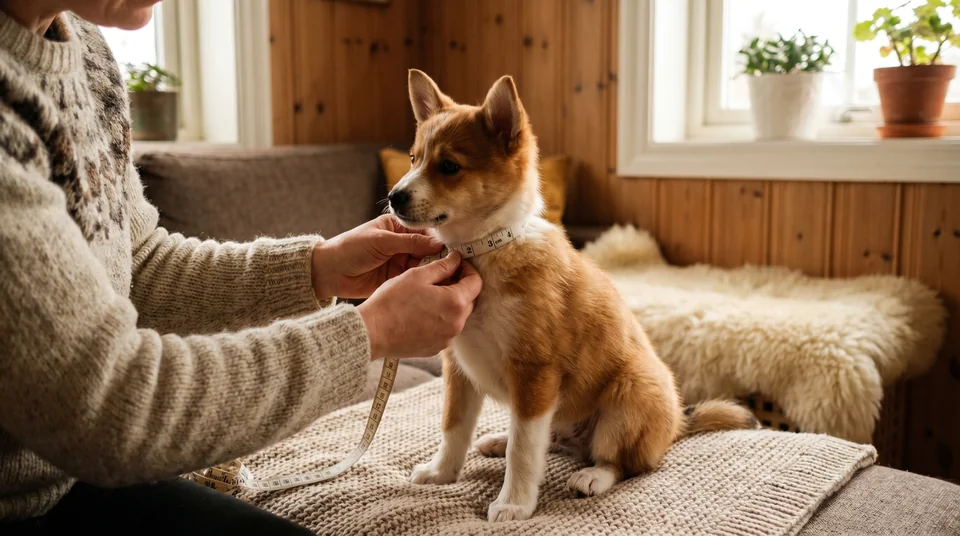
Choosing the wrong size is the most common mistake. Here is the method:
- Use a soft measuring tape — or a piece of string that you then measure against a ruler.
- Measure around the narrowest part of the neck — usually the middle of the neck, rather than up by the head or down at the shoulders.
- Add 2–3 cm to obtain the correct wearing circumference. You should always be able to place two fingers flat beneath the collar.
The two-finger rule is the gold standard: if you can fit two fingers side by side between the collar and the skin, the size is right. Too tight is uncomfortable; too loose and it may slip off.
Typical measurements for common puppy breeds:
| Breed/size | Age | Typical neck circumference |
|---|---|---|
| Small breed (Chihuahua, toy breeds) | 8–16 weeks | 15–22 cm |
| Medium breed (Beagle, Spaniel) | 8–16 weeks | 22–30 cm |
| Large breed (Labrador, Golden Retriever) | 8–16 weeks | 28–38 cm |
| Extra-large breed (Bernese Mountain Dog, Rottweiler) | 8–16 weeks | 35–45 cm |
Remember: these are guidelines. Always measure your own puppy. Large breeds in particular can have an unusually broad head and a narrow neck, making standard charts unreliable.
Materials: what is best for sensitive puppy necks?
The choice of material may be the most important decision. Let us look at the most common options:
Nylon — inexpensive, but with drawbacks
Nylon is the most widespread material on the market, and for good reason — it is cheap to produce. But it has clear weaknesses for puppies. Woven nylon absorbs water and dirt, dries slowly and, when damp, can cause skin irritation and the beginnings of infections around the neck and behind the ears. Norway's climate — rain, snow and muddy paths — is not nylon's best friend.
Nylon is fine as a very first temporary solution, but it is not ideal for daily use in Norwegian conditions.
Leather — classic, but not always practical
Leather collars are attractive, sturdy and long-lasting — but they need care. Leather that repeatedly gets wet and dries without treatment cracks and stiffens. It can become uncomfortable against a puppy's skin and, in the worst case, cause abrasions. Leather is also heavier than nylon and waterproof webbing, which is not ideal for the smallest puppies.
If you want leather, choose good quality and wax it regularly. Norwegian weather demands some effort.
Waterproof webbing — the best choice for puppies in Norwegian conditions
Waterproof webbing is a coated material combining leather's flexibility with almost no maintenance requirements. It is 100% waterproof, dries immediately, withstands mud and sand, and has no edges that scratch. The surface is smooth enough not to irritate sensitive puppy skin, yet robust enough to last for years.
That is why coated webbing is now a preferred material among dog trainers, agility enthusiasts and dog owners who put practicality before price. For Norwegian puppies — experiencing rain and damp walks from day one — it is the natural choice.
Our dog collars are made from this very material: waterproof webbing with a honeycomb texture and matt black fittings. They are light enough for puppies, adjustable and keep their shape year after year.
Our waterproof bestsellers — made for Norwegian weather

Dog leads
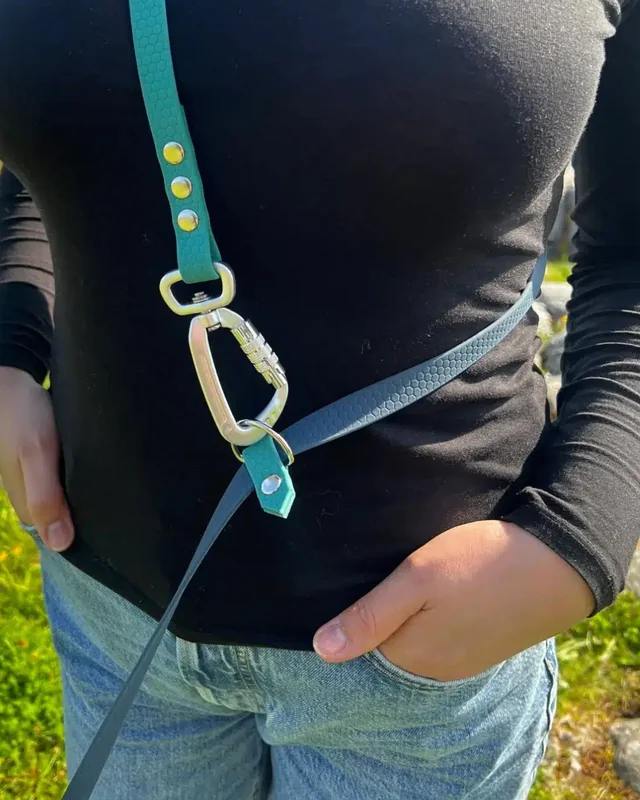
Hands-Free Dog Lead
from NOK 399.00
Hands-free dog lead in waterproof material, worn around the waist or over the shoulder. Available in 10 mm, 16 mm and 25 mm widths. Ideal as a running belt for jogging, hiking…
View product and customise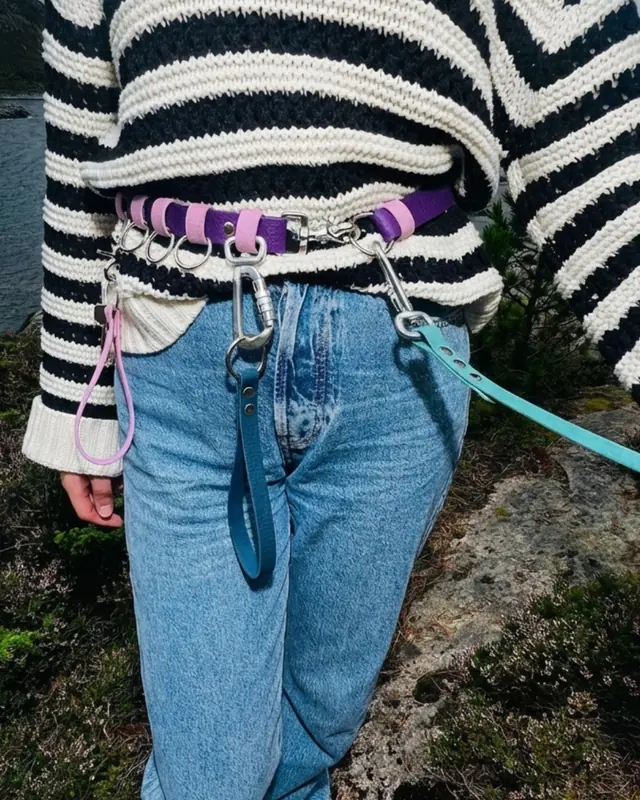

Belts
Adjustable Multifunctional Belt
from NOK 449.00
Adjustable dog walking belt in 16 mm or 25 mm waterproof webbing, designed for hands-free walks and dog sports. Fits sizes S to XL. Attach the lead to the belt and keep…
View product and customise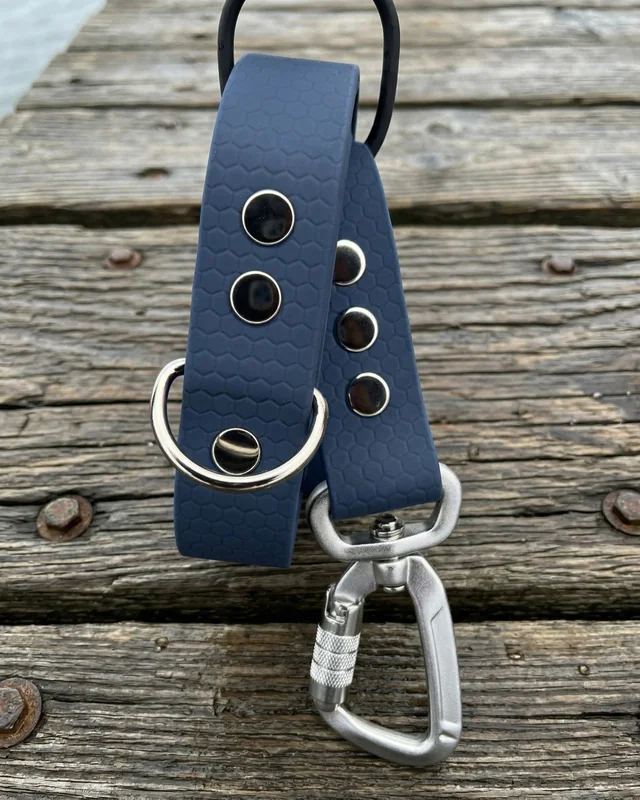

Dog leads
Classic Dog Lead
from NOK 329.00
Handmade dog lead in waterproof material with a honeycomb pattern for grip. Choose between three widths and lengths from 1.2 to 5 metres. Handles all kinds of weather, mud and…
View product and customiseCollar versus harness for a puppy — what is recommended?
We are often asked this question, and the answer is: both have their place, but they serve different purposes.
A harness spreads pressure across the chest and shoulders, which is helpful if your dog pulls hard on the lead. For puppies that have not yet learnt to walk politely, a harness can protect against neck injuries.
But harnesses also have drawbacks for puppies:
- They are harder to put on and take off quickly.
- A poorly fitted harness can rub beneath the front legs.
- Some puppies see a harness as a signal that something exciting is about to happen, and become hyperactive at the sight of it.
- A harness does not provide identification — a collar with an ID tag does.
The practical solution many experienced dog owners use: a collar all the time (for identification and easy control), and a harness during the walk itself if the puppy pulls a lot. As your puppy learns to walk politely on a lead, you can gradually move towards using the collar alone on walks.
Want to teach your puppy to stop pulling? Read our guide to dogs that pull on the lead — the principles apply just as well to puppies as to adult dogs.
How to get your puppy used to a collar
Most puppies accept a collar without difficulty. But some breeds — especially those with stronger temperaments and greater sensory sensitivity — need a little extra time. Here is a gradual method that works:
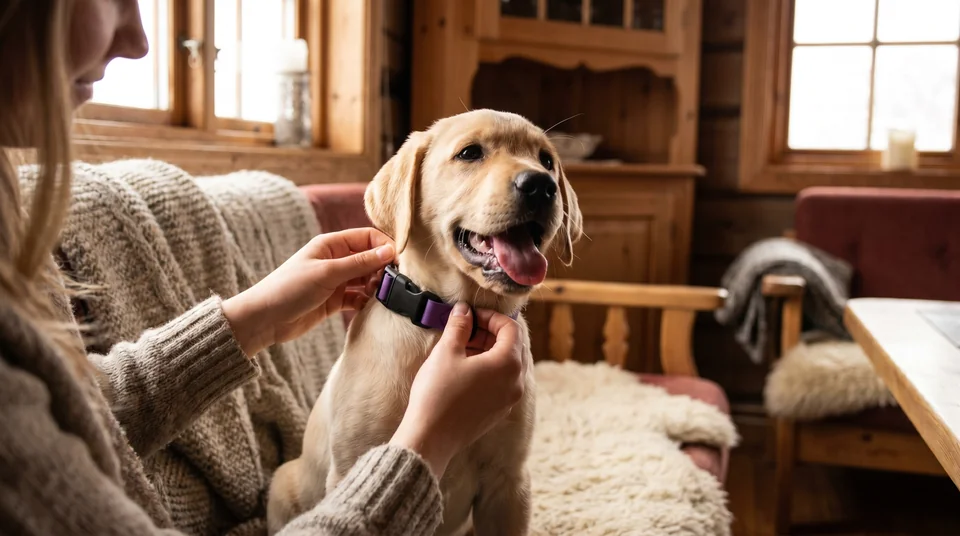
Days 1–2: Familiarity without pressure
Let your puppy sniff the collar. Place it on the floor and offer a treat nearby. The aim is a neutral or positive association — not fear.
Days 3–4: First contact
Hold the collar against the neck without fastening it. Offer a treat. Repeat 3–4 times per session. No force — just positive reinforcement.
Days 5–7: Fastened for 5 minutes
Fasten the collar and immediately distract your puppy with play or treats. Leave it on for 5 minutes, then remove it. Do not make a fuss if your puppy shakes its head — this is normal and passes.
Weeks 2–3: Making it normal
The collar stays on for longer and longer periods while you are present. After around 3 weeks, most puppies will no longer notice it.
Important: never leave your puppy sleeping in its collar alone at home during the first few weeks. It is very rare, but there have been cases of collars getting caught and causing strangulation. Once your puppy is fully accustomed to it and you are confident that everything fits correctly, the collar can gradually stay on around the clock.
How to adjust the collar as your puppy grows
Puppies — especially large breeds — can grow surprisingly quickly. A Labrador puppy can double its neck circumference in 8–12 weeks. This means you should check the two-finger rule at least once a week during the first few months.
Practical tips for keeping up with growth:
- Consider marking the hole position you are using with a pen — that lets you see quickly whether it is time to adjust.
- Choose a collar with plenty of adjustment points (ideally every 5 mm), rather than simple holes spaced 1 cm apart. Waterproof collars may have press studs or a finely adjustable buckle.
- Have a spare collar in the next size ready. Puppies do not grow to a timetable — it can happen quickly.
Checklist: the collar is too small if you cannot fit two fingers beneath it. It is too big if you can fit more than three fingers beneath it, or if it slips over your puppy's head without resistance.
Common mistakes new dog owners make with puppy collars
After speaking with hundreds of dog owners, we see the same patterns recurring:
1. Buying one collar and expecting it to last a year.
Puppies grow. Buy every six months. A collar that fits a 10-week-old puppy will not fit a 6-month-old dog of the same breed.
2. Choosing the cheapest option “because the puppy will grow out of it anyway”.
Cheap nylon against sensitive puppy skin can cause irritation and rashes. Quality material protects the skin — and a good collar can be reused for your next dog.
3. Forgetting to remove the collar during play with other dogs.
During play, a collar can catch on a playmate's teeth — a dramatic and potentially dangerous situation. Always remove the collar during free play with other dogs.
4. Using a collar that is too wide for a small puppy.
A 25 mm collar on a Chihuahua puppy is not just excessive — it can prevent normal head movement. A scaling rule: the width should not exceed 15–20% of the neck circumference.
5. Waiting too long to introduce the collar.
Many people think: “we will start with the collar when we go out”. That is too late. Familiarisation should begin at home, in a safe environment, well before the first walk.
When should you switch to an adult collar?
There is no single fixed age. It is about size and maturity — two things that vary enormously between breeds.
A general guide:
- Small breeds (adult weight under 10 kg): Can often use a “puppy collar” until they are 9–12 months old. Their growth is slower.
- Medium breeds (10–25 kg): Switch at around 6–8 months, depending on neck circumference.
- Large and extra-large breeds (over 25 kg): Many are ready for an adult collar as early as 4–5 months, but do not stop growing until 12–18 months. Choose a collar with a broad adjustment range.
A practical rule of thumb: when you have adjusted the collar to its maximum and it is still at the limit of what is comfortable, it is time to change.
The advantage of waterproof webbing is that an adult-sized collar with a good adjustment range can often be used from late puppyhood. You save money and do not have to worry about the transition.
Frequently asked questions about puppy collars
Can my puppy sleep with its collar on?
During the familiarisation period: no. Once you are confident that the collar fits correctly and your puppy is fully used to it: yes, but check regularly that it has not become too tight.
Which material is best for puppies with sensitive skin?
Waterproof webbing. It is smooth, has no edges, does not absorb moisture and is easy to keep clean. For puppies with very sensitive skin, some vets recommend trying soft neoprene — but waterproof webbing is generally safer.
Can I use the same collar throughout puppyhood?
Only if it is very adjustable. Most puppies need 2–3 collars during their first 12 months.
What should the ID tag say?
At a minimum: your telephone number. In Norway, dogs are legally required to be identified — an ID tag on the collar is the simplest solution in addition to a microchip.
Is it dangerous to use collars on large-breed puppies?
No, provided the collar is correctly fitted and you use a short lead. For large breeds that pull strongly, a harness is recommended in addition to the collar — so that the pulling force is taken by the chest rather than the neck.
What is a half-check collar, and is it suitable for puppies?
A half-check collar tightens slightly when the dog pulls, without choking. It is used mainly for dogs with a narrow neck and a large head (Greyhounds, Whippets), whose ordinary buckle collars slip off. For puppies generally: no, it is not recommended. Use an ordinary buckle collar in the correct size instead.
How much does a good puppy collar cost?
A quality waterproof-webbing collar typically costs between NOK 200 and 400. That is more than the cheapest nylon option — but it lasts considerably longer, withstands Norway's climate and is much more comfortable against the skin. Calculated per day of use, it is no more expensive.
Have questions about which size or type suits your puppy? Please get in touch — we are happy to help you find the right collar from day one.