Guides
Snap hooks for dog leads: a guide to choosing the right hook
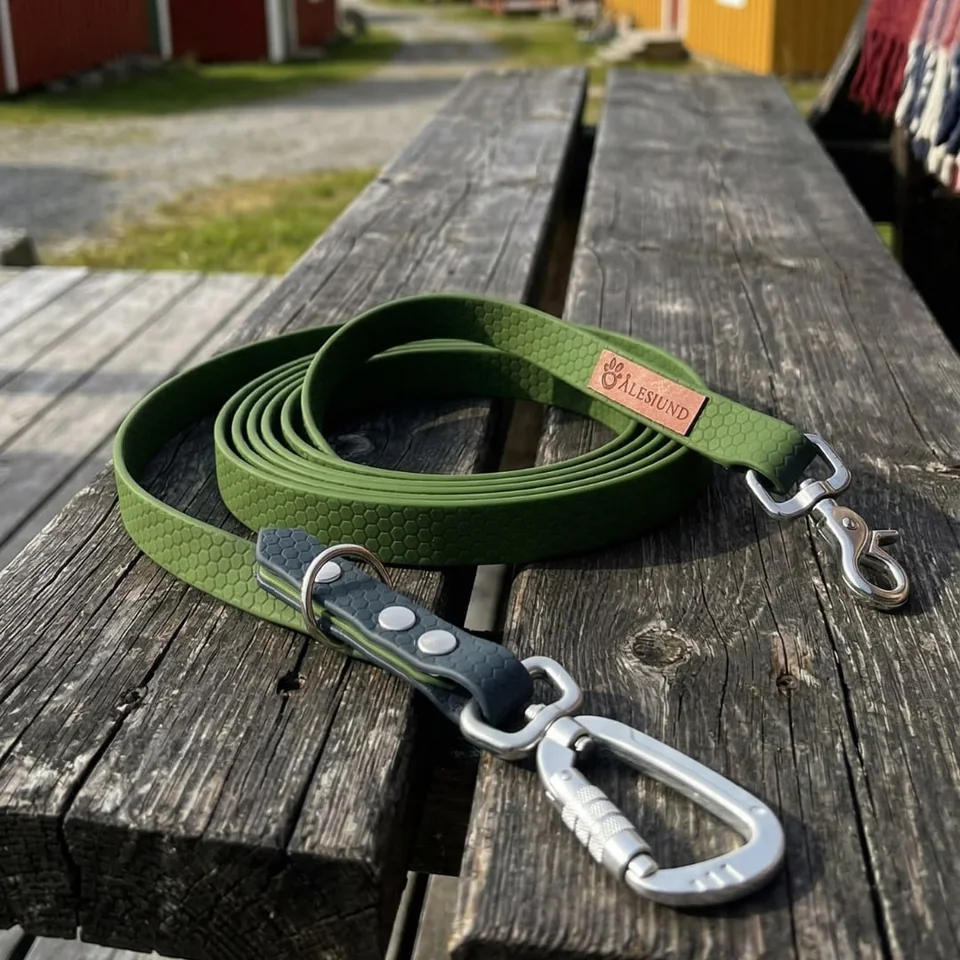
The snap hook is the smallest part of your dog lead. It is also the most important. If the lead breaks, you still have hold of the dog. If the snap hook fails, your dog is loose.
That sounds dramatic, but it happens. Cheap hooks made from poor metal break in the cold. Springs stiffen after a few months. Locks open by themselves when a dog jerks. Whenever we read about a dog that escaped because “the lead broke”, it is almost always the hook that failed, rather than the lead itself.
We have tested and used many snap hooks over the years we have been making waterproof dog leads. Here, we share what we have learnt and explain the differences between the types we use.
Two types of snap hook, and when you need each
There are many varieties of snap hook, but for dog leads it comes down to two main types: trigger snaps and locking snap hooks.
Trigger snap: the quick everyday hook
A trigger snap is the hook you recognise from most dog leads. It has a flat lever you press down with your thumb, clip onto the D-ring, and release. It takes half a second.
The mechanism is simple and reliable. A spring holds the lever closed, and it snaps back as soon as you release it. That is why trigger snaps are the standard for dog leads worldwide. They work.
Where a trigger snap falls short is when something presses against the lever from outside. Twigs, your dog's paws, or unfortunate pressure at the wrong angle can, in rare cases, push the lever in and open the hook. For most dogs in ordinary use, this is never a problem. But do you have a large, strong dog that pulls hard? Then there is something better.
Locking snap hook: for those who need extra security
A locking snap hook (twist-lock) has a screw sleeve around the gate. To open the hook, you first turn the sleeve, then press. Two movements instead of one. This means the hook cannot open accidentally, whatever your dog gets up to.
This type is common in climbing and industry, where the consequences of something opening are serious. For dogs, it is relevant for large breeds, training lines where the dog is far away from you, or simply owners who want no chance of an accident.
Clipping it on takes a couple of extra seconds. Some people find that annoying. Others think the reassurance is worth it. It depends entirely on your dog and what you do together.
The snap hooks we use at ÅlesHund
After extensive testing, we have settled on three versions. Here are the actual figures.
Trigger Snap 62 mm (chrome)
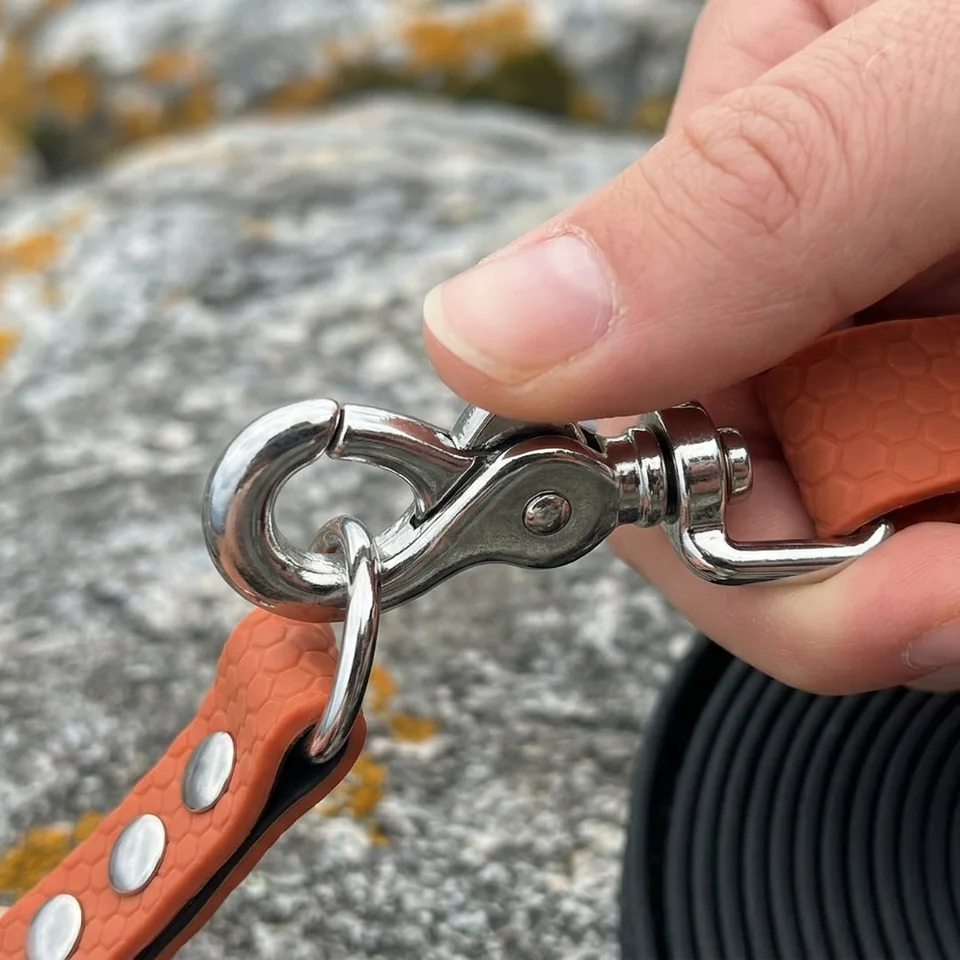
Our standard snap hook for dog leads. Made from a die-cast zinc alloy with chrome plating. It weighs 28 grams and withstands a load of 160 kg. It has a swivel eye that prevents the lead twisting when your dog turns around.
The gate opening is 16 mm, which fits most D-rings on collars and harnesses. The eye comes in 16 mm, 20 mm or 25 mm, depending on the lead width.
We use it on our Waterproof Classic Dog Lead, Hands-Free Lead and Waterproof Handle.
Trigger Snap 62 mm (matt black)
The same hook as the chrome version, just with a matt-black finish. Identical mechanism, the same weight (28 g), the same load capacity (160 kg). The difference is the appearance, and that this coating has been nickel-tested. This means it is hypoallergenic for dogs that react to nickel.
The black finish looks good with dark lead colours. It works with the same eye sizes as the chrome version.
Aluminium carabiner 86 mm (twist-lock)
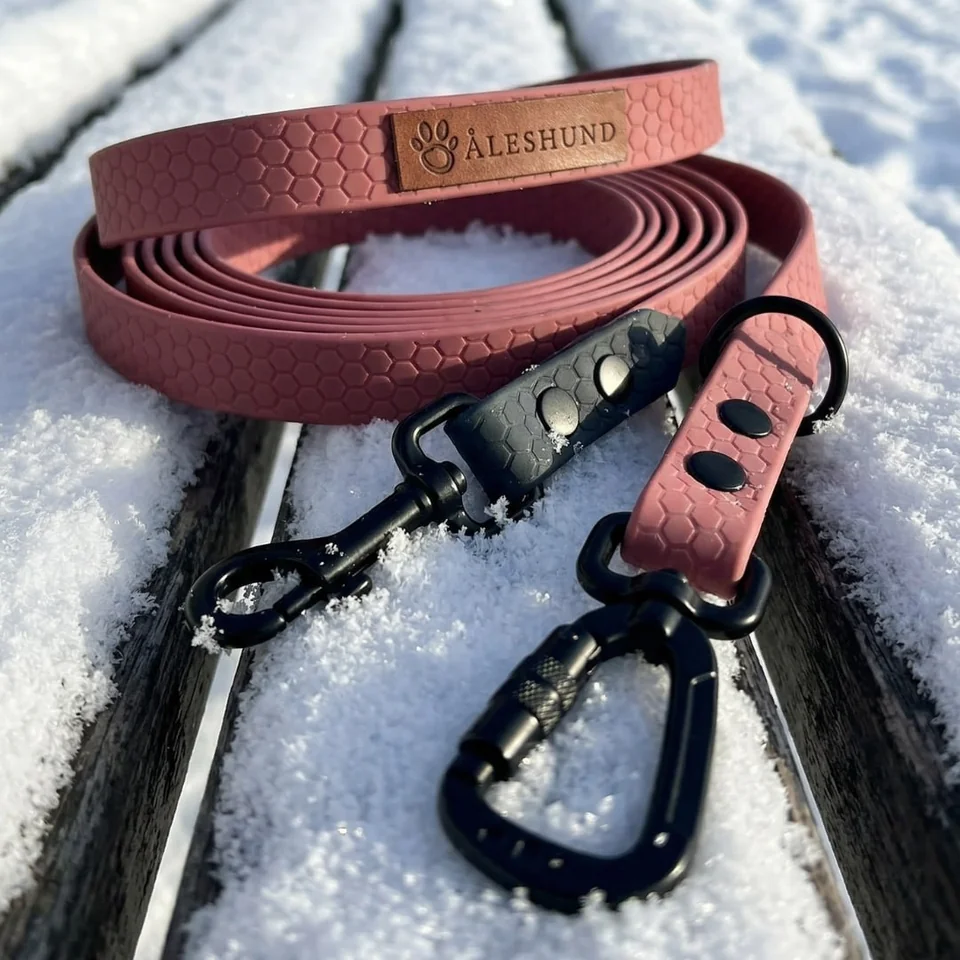
Here is where it gets interesting. This one is made from 7075 aluminium, the same alloy used in climbing carabiners and the aerospace industry. It weighs just 26 grams — lighter than the smaller trigger snap — and withstands a 400 kg load. Read that again. 400 kg.
The rotating sleeve makes it impossible to open accidentally. Turn the sleeve, press the gate in, and clip on. The eye is 25 mm, designed for 25 mm leads.
We use this on the Long Training Line and leads for large, strong dogs. Available in silver, gold and black (anodised).
To put that in perspective: a 35 kg Labrador suddenly jerking the lead might generate 80 to 100 kg of force at that moment. This hook withstands four times that. A good margin.
Which size suits your dog?
The snap-hook size follows the lead width, which in turn follows the dog's size. Here is the overview:
| Lead width | Snap hook | Suitable for |
|---|---|---|
| 16 mm | Trigger Snap 62 mm, 16 mm eye | Small and medium-sized dogs (up to approx. 15 kg) |
| 20 mm | Trigger Snap 62 mm, 20 mm eye | Medium-sized dogs (15–30 kg) |
| 25 mm | Trigger Snap 62 mm, 25 mm eye | Large dogs (over 25 kg) |
| 25 mm | Aluminium 86 mm, twist-lock | Large/strong dogs, training lines |
Unsure what you need? Go up a size. A slightly oversized hook is just a little heavier. A hook that is too small is a safety issue.
For dogs over 30 kg that pull a lot, we recommend an aluminium twist-lock. Not because a trigger snap is unsafe (160 kg is still plenty), but because the twist-lock gives you the extra reassurance that the hook will never open unintentionally.
Materials: what is the difference?
Die-cast zinc alloy (our trigger snaps)
Die-cast zinc is a common material for dog-lead hardware. It is heavy enough to feel solid, and with the right coating (chrome or matt black), it holds up well over time. A load capacity of 160 kg is more than enough for almost all dogs.
Some people warn against “cheap zinc hooks”, and that is partly justified. The problem is not zinc itself, but poor quality control. Thin walls, uneven casting, weak springs. Our version is thicker, heavier and withstands more than what you find on dog leads from discount chains.
7075 aluminium (our twist-lock)
7075 aluminium is in a class of its own. It is the strongest commercially used aluminium alloy, with a strength-to-weight ratio that beats most steels. That is why it is used in aircraft, climbing carabiners and racing bicycles.
For dog leads, this means: very strong, surprisingly light (26 g for an 86 mm carabiner), and rust-free. The anodised surface resists scratches and wear. It does not rust. It does not corrode in salt water. It does not break in the cold.
The drawback? It costs more than a zinc hook. But you are paying for something that lasts and gives you an extra margin on those days when your dog decides to chase a roe deer.
What about plastic?
Some dog leads, especially cheap ones, have snap hooks made from plastic or nylon. Our recommendation: avoid them. Plastic becomes brittle in the cold, weakens over time with UV exposure, and has no place on equipment intended to keep your dog secure. There may be uses for plastic hooks, but dog leads are not one of them.
Our waterproof bestsellers — made for Norwegian weather

Dog leads
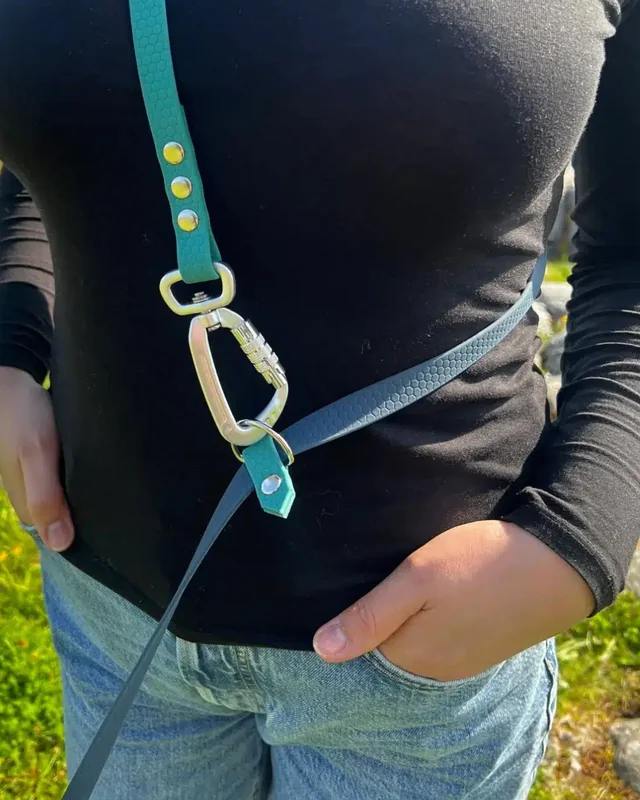
Hands-Free Dog Lead
from NOK 399.00
Hands-free dog lead in waterproof material, worn around the waist or over the shoulder. Available in 10 mm, 16 mm and 25 mm widths. Ideal as a running belt for jogging, hiking…
View product and customise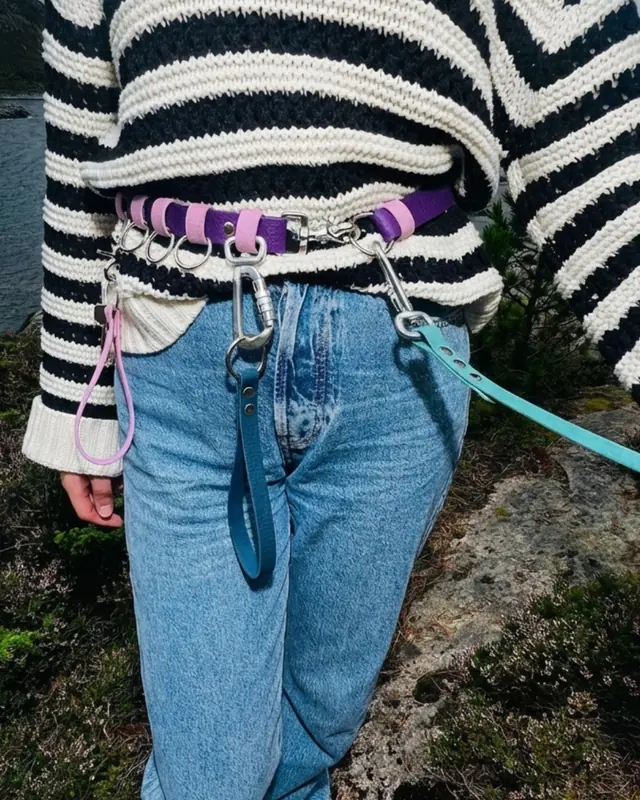

Belts
Adjustable Multifunctional Belt
from NOK 449.00
Adjustable dog walking belt in 16 mm or 25 mm waterproof webbing, designed for hands-free walks and dog sports. Fits sizes S to XL. Attach the lead to the belt and keep…
View product and customise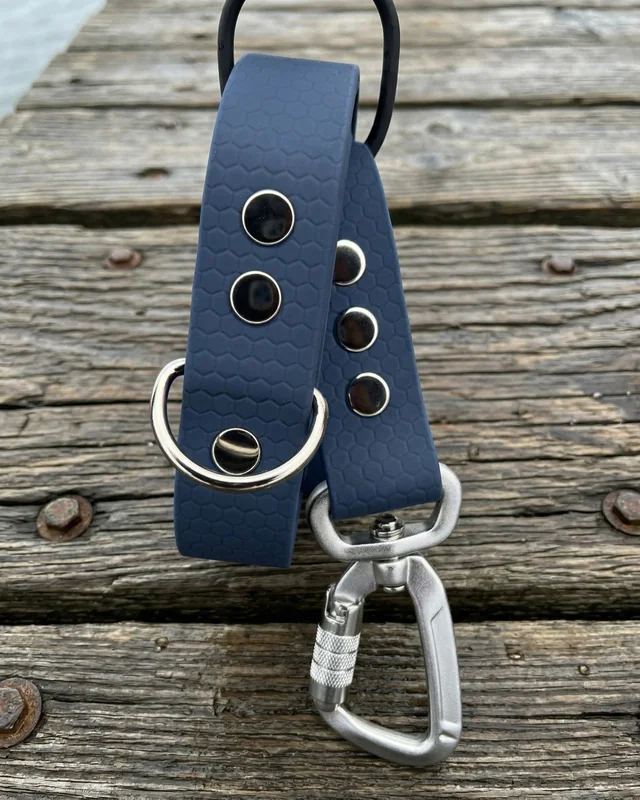

Dog leads
Classic Dog Lead
from NOK 329.00
Handmade dog lead in waterproof material with a honeycomb pattern for grip. Choose between three widths and lengths from 1.2 to 5 metres. Handles all kinds of weather, mud and…
View product and customise5 things to check when choosing a snap hook for a dog lead
1. Load capacity
Check how many kilos the hook withstands. The minimum should be 3 to 4 times your dog's weight. A 25 kg dog needs a hook that withstands at least 75 to 100 kg. Our trigger snaps withstand 160 kg; the aluminium twist-lock withstands 400 kg.
2. Locking mechanism
An ordinary trigger snap is adequate for most dogs. If you have a large or reactive dog, consider a twist-lock. It is especially relevant beside roads, during training, or if your dog has a talent for escaping.
3. Swivel eye
A snap hook without a swivel makes the lead twist. After a few walks, you have a permanently twisted lead that is irritating to use. All our trigger snaps have a built-in swivel.
4. Material and surface treatment
Chrome plating and anodising protect against corrosion. Check that the coating is even and free of bubbles. A nickel-tested finish is a plus if your dog has sensitive skin.
5. The right size
The snap hook must match the lead width. A hook that is too narrow for a wide lead hangs at an angle and is loaded incorrectly. A hook that is too wide for a narrow lead is unnecessarily heavy and bulky. Check the table above.
Frequently asked questions about dog-lead snap hooks
Does every dog need a locking snap hook?
No. For small and medium-sized dogs that do not pull very much, a good trigger snap is entirely sufficient. A 160 kg load capacity is far more than a 15 kg dog can generate. Twist-locks are most relevant for large breeds, dogs that pull hard, and situations where losing your dog would have serious consequences (near traffic, wildlife, etc.).
Can I use an ordinary climbing carabiner as a dog-lead snap hook?
Technically yes, but it is impractical. Climbing carabiners are intended to be attached with both hands, and are not designed for quick, one-handed clipping and unclipping. Dog-lead snap hooks have trigger or bolt mechanisms that make everyday use much easier. Our aluminium twist-lock gives you the strength of a climbing carabiner in a format that works for dog leads.
Do snap hooks rust?
It depends on the material. Chrome-plated zinc hooks withstand ordinary rain and snow well, but prolonged saltwater exposure can cause corrosion over time. Anodised 7075 aluminium does not rust at all. Whatever the type: rinse the hook in fresh water after beach walks and wipe it dry. It takes ten seconds and extends its lifespan.
How long does a snap hook last?
With normal use and a little maintenance: several years. Check the spring regularly. Press the lever in and release it; it should snap back immediately. If it is sluggish, it is time for a replacement. Look for visible wear, cracks or rust. Most problems occur with cheap hooks after 6 to 12 months. Quality hooks last 3 to 5 years or more.
What is the difference between a trigger snap and a bolt snap?
A trigger snap has a flat lever you press down. A bolt snap has a round lever you slide backwards. Bolt snaps are more compact and harder to open accidentally, but also slower to use, especially with gloves. We use trigger snaps because they offer the best balance of security and ease of use for everyday dog walking.
Find the right dog lead with the right snap hook
We have done the work of matching snap hooks to lead widths and uses. You do not need to think about it — just choose according to your dog's size and what you do together.
- Waterproof Classic Dog Lead (NOK 329) — chrome or black trigger snap, available in 16/20/25 mm
- Waterproof Hands-Free Lead (NOK 399) — for keeping your hands free, trigger snap with swivel
- Long Training Line (NOK 599) — aluminium twist-lock, 400 kg load capacity, for training and recall
- Waterproof Handle (NOK 99) — short and practical, trigger snap
- Adjustable Multifunctional Belt (NOK 449) — hands-free with a snap hook for active walks
Everything is made from waterproof webbing that withstands mud, rain, snow and seawater without smelling or going mouldy. Combine it with the right snap hook, and you have equipment that lasts.
Have questions about which snap hook suits your dog? Send us a message, and we will help you find the right arrangement.