Dog running leads — running with your dog without stress
Updated March 2026 · Reading time: approx. 8 minutes
I started running with my dog three years ago. Not because I was particularly motivated. Quite the opposite. I needed someone to get me out of the door at six in the morning, whatever the weather. And it worked. My dog does not care that it is raining, that it is Monday, or that I slept badly. He wants to go out. And suddenly we are both running.
Running with your dog is simply one of the best forms of exercise you can choose — for both you and your four-legged friend. Dogs need daily exercise, and a good run provides both physical activity and mental stimulation. For you, it means better fitness, lower stress levels and a training partner who never cancels.
But one thing can spoil the whole experience: the wrong equipment. An ordinary lead in your hand while you try to maintain a steady rhythm? That is a recipe for frustration — and, in the worst case, injuries. Fortunately, there is a simple solution: a proper dog running lead that lets you run hands-free.
In this guide, we cover everything you need to start running with your dog — from the right equipment to practical tips and Norway's compulsory lead rules.
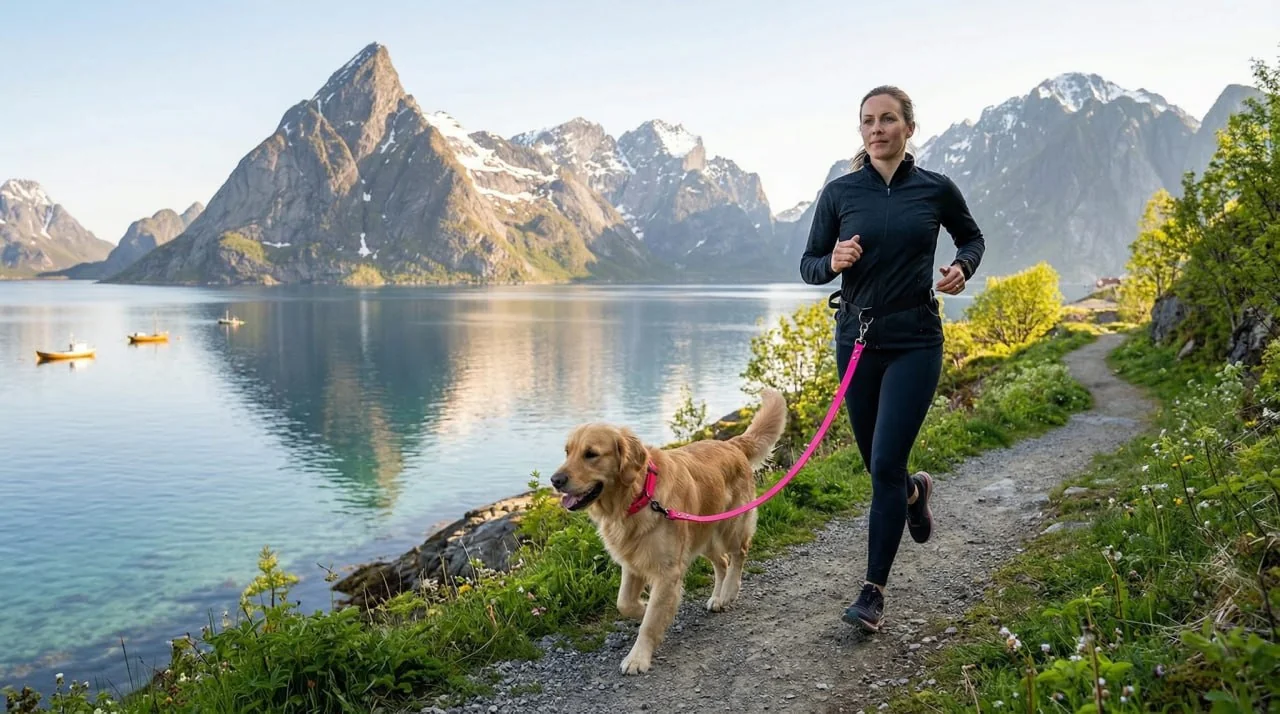
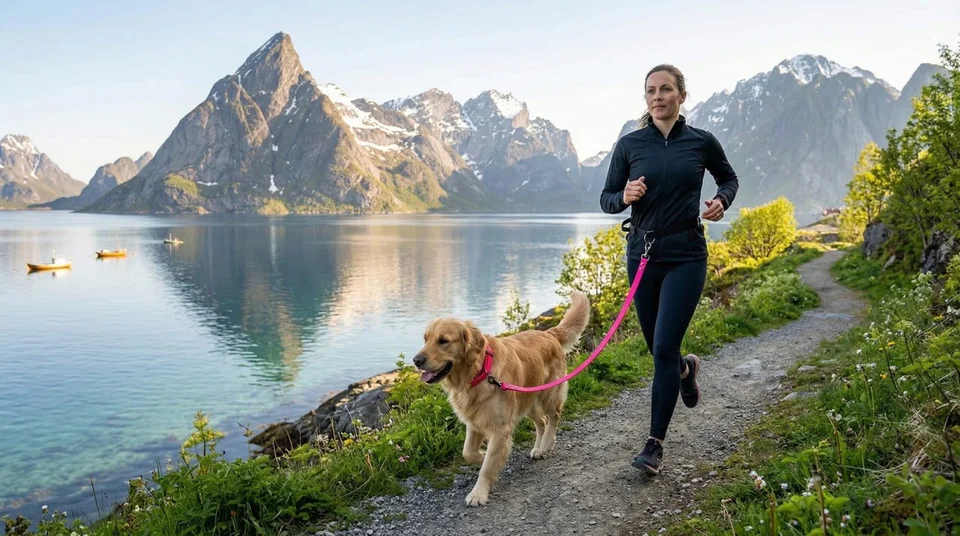
With the right running lead, you can enjoy a run along the fjord — hands-free and stress-free.
What do you need to run with your dog?
The short answer: a hands-free dog lead and a good belt. That is it. You do not need a fancy GPS watch, specialist leggings or expensive running shoes (although they help). But you do need to move on from the ordinary lead you use for walks.
Why? Because holding a lead in your hand while running is tiring, impractical and actually dangerous:
Body imbalance: you hold one arm rigid to control your dog, causing uneven loading and tension in your shoulder, neck and back.
Risk of falling: if your dog suddenly jerks — after a squirrel, another dog, anything — you can lose your balance and fall.
Poor running technique: with a lead in your hand, you cannot use your arms naturally. Your running technique suffers and you use more energy.
Stress for your dog: your dog feels jerks and pulls from your hand. That creates unease rather than cooperation.
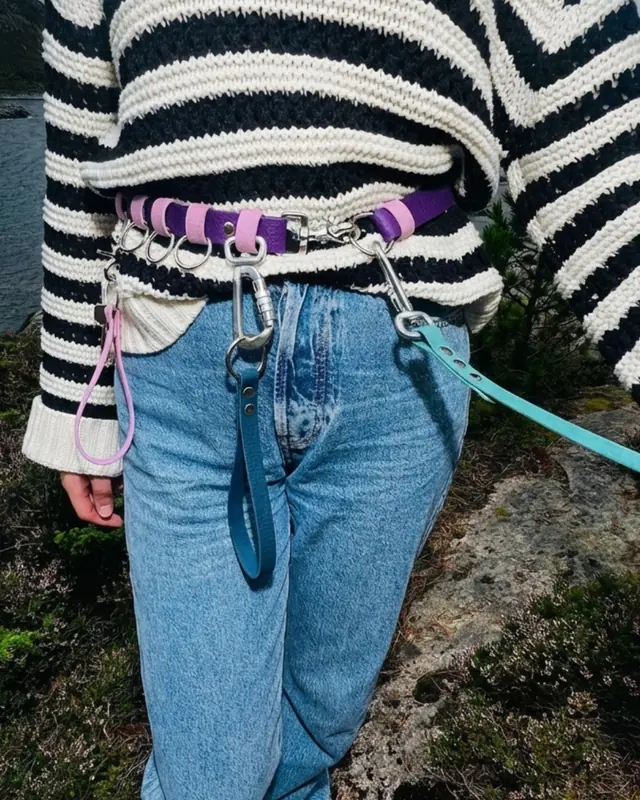
The solution is a proper dog running lead — a lead for running that fastens around your body, either directly around your hips or through a belt. Your hands are free, your body stays balanced, and your dog receives steadier guidance.
Our waterproof bestsellers — made for Norwegian weather
If you buy just one thing for running with your dog, it should be a hands-free lead. It is the running lead itself. The connection between you and your dog that makes everything possible.
Our waterproof hands-free lead is designed specifically for active dog owners here in Norway. That means it stands up to Norwegian weather — whether pouring rain in Bergen or sleet in Ålesund.
What makes this lead special?
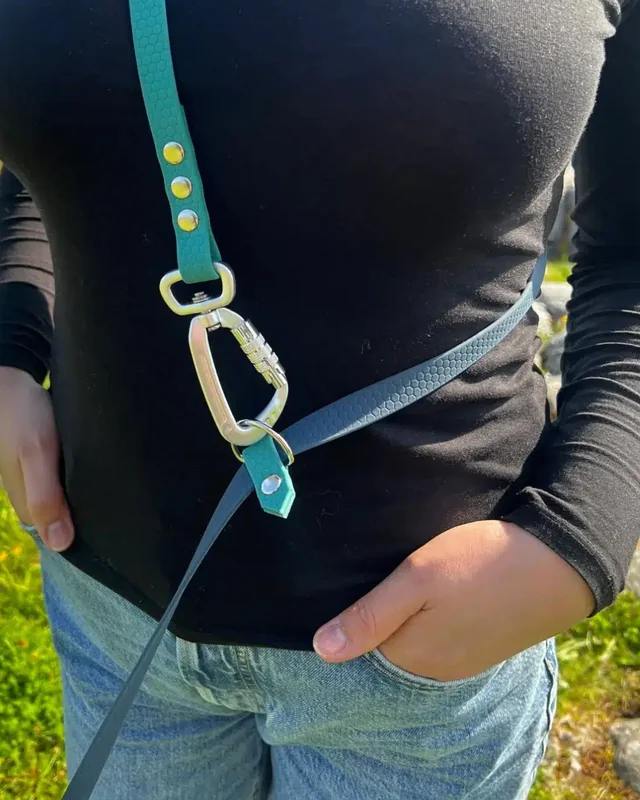
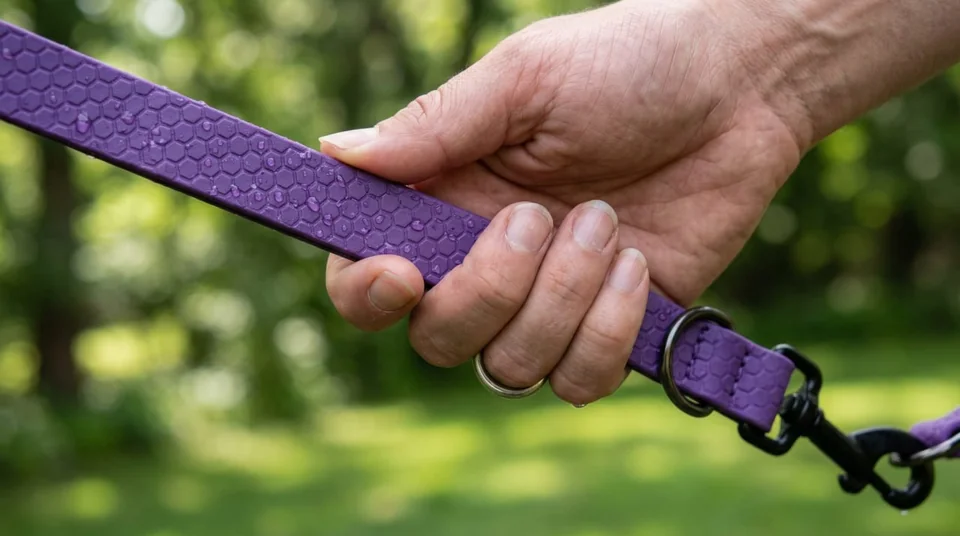
The honeycomb pattern provides a good grip — even with wet hands.
Honeycomb pattern for grip: the surface has a honeycomb pattern that gives good grip even with wet hands. Perfect for the days you forgot your gloves.
100% waterproof: not merely water-resistant, but completely waterproof. The material does not absorb water, dries in seconds and does not smell unpleasant after a walk in the rain.
Flexible attachment: can be worn around your hips, over your shoulder, or used as an ordinary hand-held lead. You choose what suits your running style.
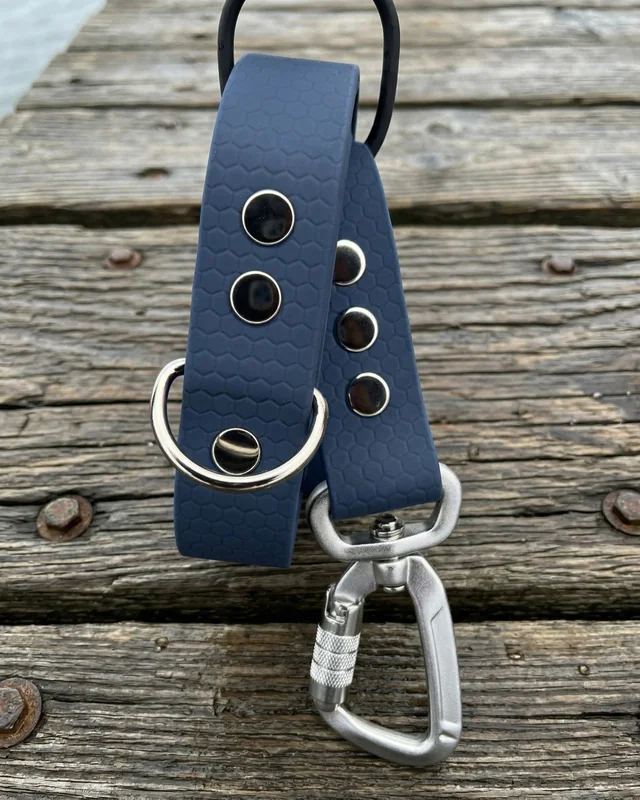
Strong snap hooks: the hooks are made to withstand sudden pulls without opening. That gives reassurance when your dog spots something exciting.
Handmade in Ålesund: every lead is handmade by ÅlesHund here in Ålesund. We know what Norwegian weather demands of dog equipment.
You can use the lead on its own around your hips for a simple run. But for the best experience — particularly on longer outings — we recommend combining it with a proper belt.
Multifunctional belt — a complete hands-free arrangement
If you want to be really comfortable, a dedicated running belt is the next step. The belt distributes the forces from your dog evenly around your hips, so you barely notice the pull.
Adjustable size S–XL: fits most body shapes. Tighten it for running, loosen it for walking.
Wide and padded: the belt is broad enough to distribute pressure without digging in. Even if your dog jerks, it feels like an even pull — rather than a tight strap cutting in.
Multifunctional: use it for running, hiking, walking, or simply when you want your hands free for your coffee. It works with every type of lead.
Light and discreet: weighs next to nothing and fits comfortably beneath your jacket without showing.
The hands-free lead + belt combination is what we recommend for anyone who wants to run with their dog regularly. NOK 848 in total for a complete hands-free running set that lasts for years.
Training line — perfect for warming up before your run
Before picking up the pace, it is wise to let your dog sniff and go to the toilet in peace. A long dog training line (5–10 metres) gives your dog freedom to explore while you warm up with gentle walking or stretching.
A training line is also excellent for practising recall and obedience — which makes the run itself much more enjoyable afterwards. Once your dog has worked off its initial excitement, switch to the hands-free lead and get going.
Tips for running with your dog — how to do it right
It is not simply a matter of lacing up your shoes and heading out. Here are the most important things to consider.
Choose the right breed (or accept the one you have)
Some dogs are born to run. Others are less so. Breeds well suited to running include:
Border Collie — endless energy, loves working
Labrador Retriever — good stamina and enthusiastic about any activity
Weimaraner — built for speed and distance
Dalmatian — historically a running dog, needs plenty of exercise
Australian Shepherd — energetic and eager to learn
Jack Russell Terrier — small, but surprisingly enduring
Short-nosed breeds such as Pugs, Bulldogs and Shih Tzus struggle with breathing and should not be used as running dogs. The same applies to very heavy breeds such as St Bernards.
And remember: no dog under 12–18 months should run long distances. Their skeleton is not fully developed, and the strain can cause lasting damage to joints and bones.
Warming up — for you and your dog
Start with 5–10 minutes of gentle walking. Let your dog sniff, go to the toilet and get mentally ready. Do some stretches yourself. Do not jump straight into a fast pace — that applies to both of you.
Match your pace to your dog
Your dog has a natural trot that is most energy-efficient. Try to find that pace and maintain it. For most medium-sized dogs, this is around 6:00–7:00 min/km — a comfortable jogging pace for most people too.
Avoid hot days
Dogs regulate their body temperature through their paws and by panting. They overheat much faster than we do. Above 20 °C, you should skip the run or move it to early morning / late evening. Sun-heated tarmac can burn paws — place your hand flat on it for 5 seconds. If it is uncomfortable for you, it is too hot for your dog.
Build up gradually
First outing: 10–15 minutes at a gentle pace. Add 5 minutes per week. After 4–6 weeks, most dogs can run comfortably for 30–45 minutes. But watch your dog closely — limping, heavy breathing or lying down are signs that it is too much.
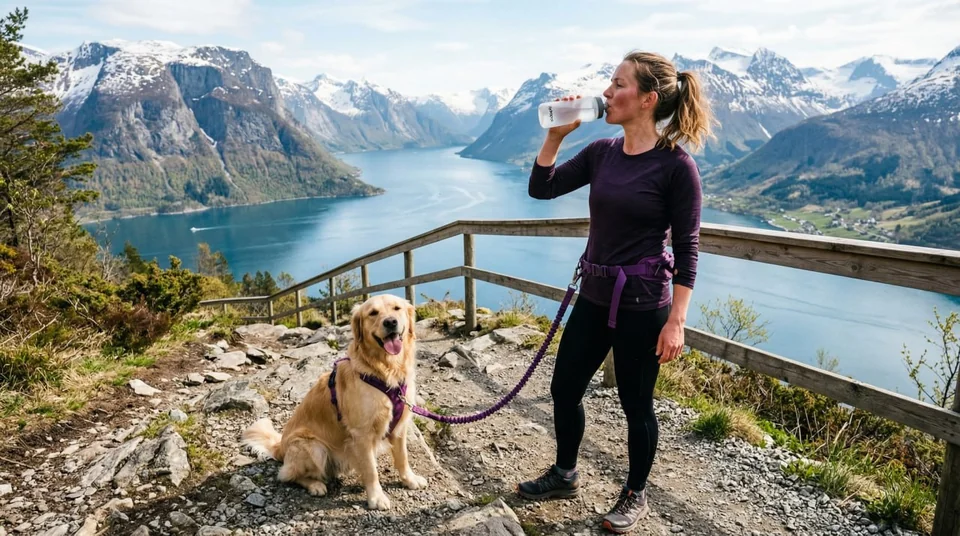
Remember a water break — for you and your dog.
Bring water
Always. Especially on outings longer than 20 minutes. A collapsible water bowl weighs nothing and can save your dog from dehydration.
Lead requirements and running — what you need to know
In Norway, the general compulsory lead requirement applies from 1 April to 20 August. This means your dog must be on a lead — including when you run. Some municipalities extend the requirement throughout the year in specific areas.
But here is the good part: with a hands-free dog lead, this is no problem. Your dog is safely on a lead and your hands are free for natural running. The lead requirement becomes a non-issue when you have the right equipment.
We also recommend running with your dog on a lead outside the compulsory period. Even the most obedient dog can react unpredictably to an animal, a cyclist or a child. With a good dog running lead, you are secure — which means you can relax and enjoy the outing.
Frequently asked questions about running leads and running with your dog
What is a dog running lead?
A dog running lead is a hands-free lead that fastens around your hips or through a belt, letting you run with your dog without holding anything in your hands. It provides better balance, natural running technique and a safer experience for both of you.
How old must my dog be before running?
Your dog should be at least 12–18 months old, depending on the breed. Larger breeds need longer because their skeleton takes more time to develop fully. Speak to your vet to be sure.
Can all dog breeds run?
No. Short-nosed breeds such as Pugs and Bulldogs are not suitable for running because of their breathing difficulties. Most medium-sized and large breeds with a normal muzzle cope well with running, but build up gradually.
Is running with a dog off the lead legal?
During the compulsory lead period (1 April – 20 August), dogs must be on a lead throughout Norway. Outside that period, the rules vary by municipality and area. See our guide to the lead requirement for details.
How far can I run with my dog?
It depends on breed, age and fitness. Start with 1–2 km and build up over several weeks. Most healthy adult dogs can run 5–10 km after gradual training. Some breeds can manage even more.
What should I do if my dog pulls a lot?
Start by training loose-lead walking before running. A hands-free lead with a belt helps because the pull is distributed evenly around your hips rather than through your hand. Start at a gentle pace and reward your dog for staying beside you.