Guides
Hands-free dog leads — what you need to know
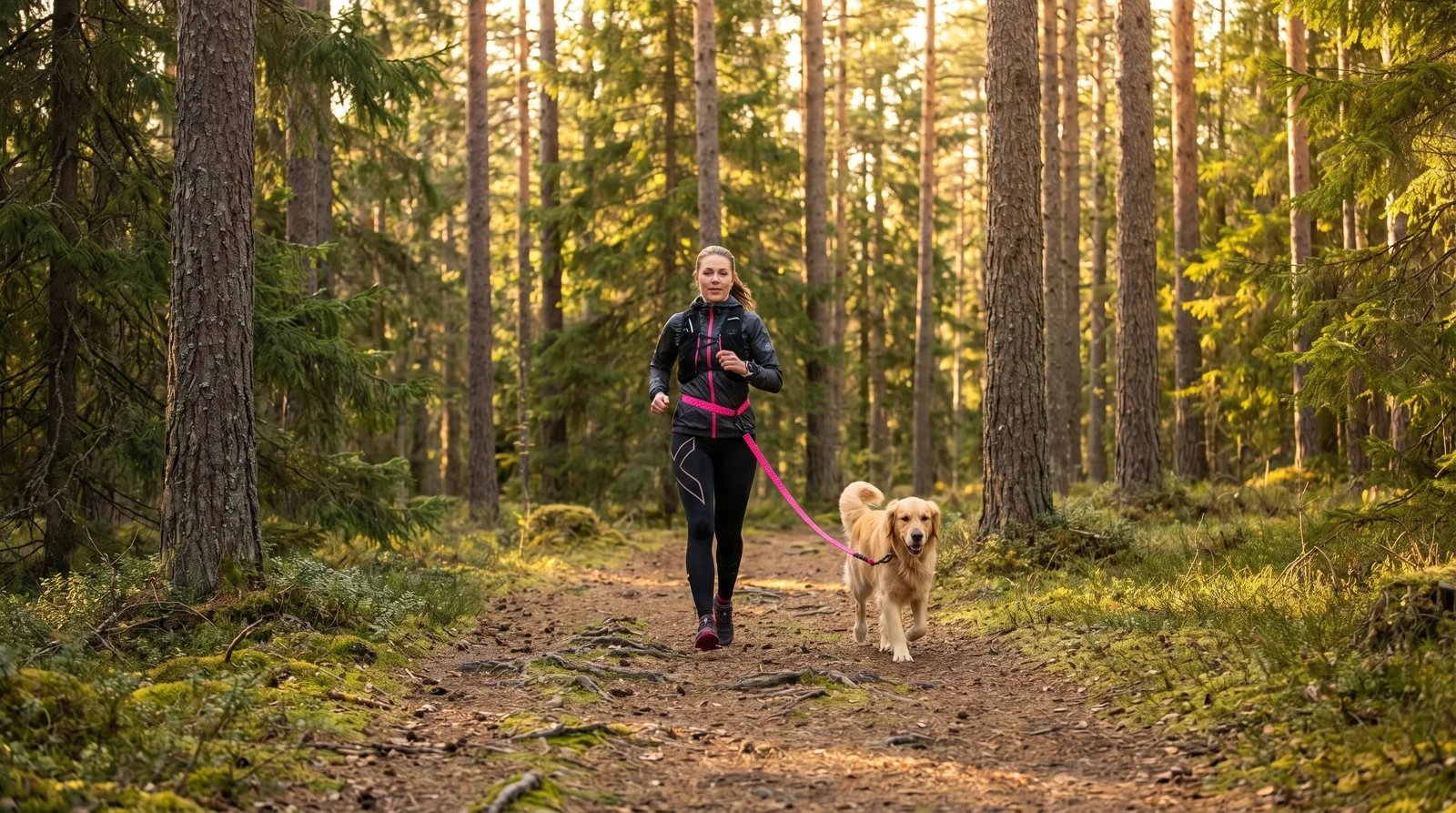
Have you tried holding a dog lead while running uphill, pushing a pram, or simply wanting your hands free? It is not exactly ideal. A hands-free dog lead solves that.
A hands-free lead — often called a “kobbel” in Norwegian — fastens around your hips. Your dog walks beside you. You let go of the lead. It sounds simple, and it really is.
Contents
- What is a hands-free dog lead?
- Who is a hands-free lead suitable for?
- Hands-free leads for jogging
- Hands-free leads on woodland walks
- The difference between a hands-free lead and an ordinary dog lead
- Nylon vs waterproof webbing
- Choose the right width
- The most common mistakes
- Lead + belt
- Waterproof hands-free leads
- Which dogs are they suitable for?
What is a hands-free dog lead?
A hands-free dog lead attaches to the owner rather than being held in the hand. Most models have a belt around the hips and a lead — often with a little stretch — attached to the dog's harness or collar with a snap hook.
It is not the same as an ordinary dog lead held in your hand. The attachment point is your body — around your hips or waist. This means your dog's pull is distributed across your whole midsection, rather than your wrist and shoulder. For people using a lead for hours, that difference is noticeable.
A good hands-free lead has an adjustable length, a sturdy snap hook and a belt that stays in place as you move.
Who is a hands-free lead suitable for?
The shortest answer: almost anyone with a dog.
But there are some groups for whom it really makes a difference. Joggers no longer hold a lead and can run normally with a full arm swing. Walkers want their hands free for poles, maps and cameras — especially on Norwegian terrain, where trails are uneven and often slippery. Parents with a pram know how awkward it is to push with one hand and hold the dog lead with the other — a hands-free lead gets around that problem.
And people with joint pain or reduced grip strength appreciate not having to hold a taut lead for hours — the hands-free lead takes the strain for them.
Hands-free leads for jogging — how they work
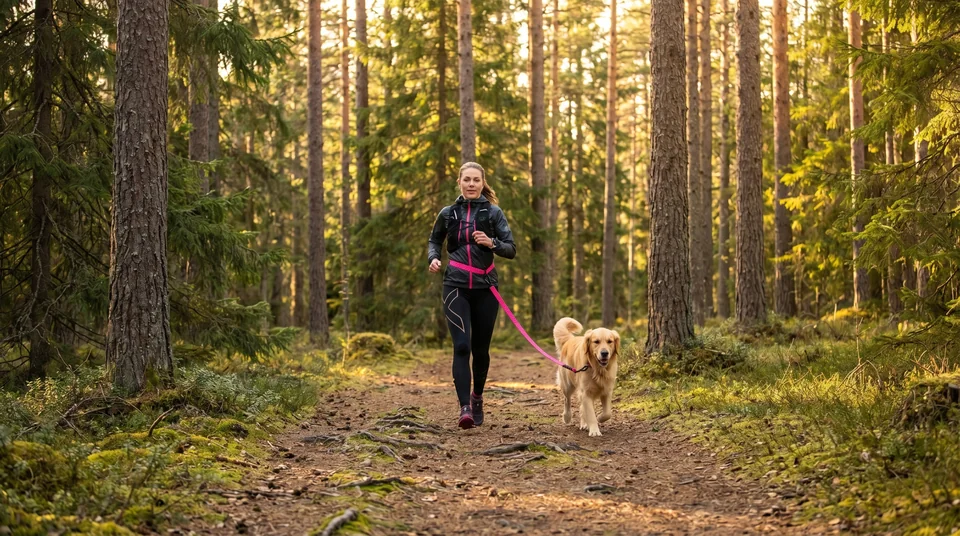
Most hands-free running leads are 16 mm wide and have a stretchy section to absorb sudden pulls. When your dog suddenly stops to sniff, the lead's stretch takes the shock instead of your head or shoulder.
For jogging, a 16 mm width is recommended. It is light enough to forget about, yet strong enough for dogs up to 30–35 kilos. 25 mm is better for large, powerful pulling breeds.
One thing to remember: a jogging lead works best with dogs that can at least walk to heel. Not necessarily perfectly — but they should not turn 180 degrees every minute. The lead is a tool, not a miracle cure for bad habits. Read more about training in our guide to dogs that pull on the lead.
Want to combine a hands-free lead with jogging? We have also written a separate guide to dog running leads, covering the complete arrangement.
Hands-free leads on woodland walks
On countryside walks, a hands-free lead really proves itself. You are walking with poles, carrying berries or a small rucksack. Your dog stays close to you. You do not need to use a hand for the lead.
On slippery terrain — Norwegian woodland from September to May is not known for dry ground — having both hands free is an advantage. You can grab trees, keep your balance and use poles. Your dog is still attached to you, but you are not chained to the lead.
ÅlesHund's hands-free leads come in 10, 16 and 25 mm widths. All use waterproof webbing with a honeycomb pattern — the material does not absorb mud or muddy water, and dries quickly.
What actually is the difference between a hands-free lead and an ordinary dog lead?
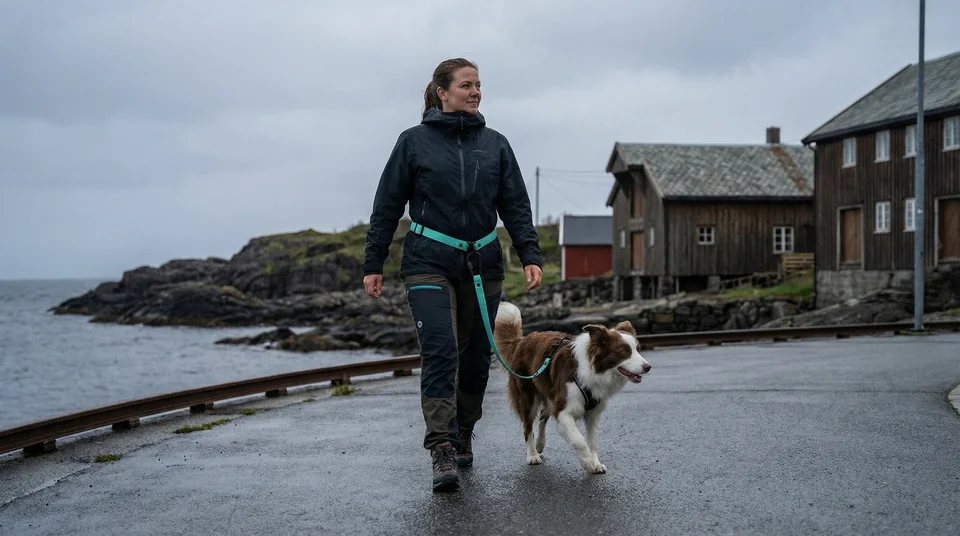
It comes down to where the pull goes.
With an ordinary lead in your hand, your shoulder, arm and wrist take the dog's pull. That is fine for a few minutes, but tiring for an hour.
With a lead around your hips, the pull is distributed towards your midsection — closer to your body's centre of gravity. You use your whole body to stabilise, rather than just your arm. It is simply more comfortable on long walks.
One drawback worth mentioning: with a hands-free lead, you are more closely connected to your dog. If it suddenly sprints after a hare, you feel it. Without warning. That is why hands-free leads work best for dogs with basic obedience — or as part of a training programme.
Nylon vs waterproof webbing — which is best for Norwegian conditions?
Nylon hands-free leads are cheap. They work well in dry weather. But nylon absorbs water and mud, starts smelling after a few uses, and stiffens in cold air. In winter, a nylon lead can become stiff and difficult to handle.
Waterproof webbing is different. It is a synthetic material — a polyester core with an outer polyurethane layer — that neither absorbs water, smells nor stiffens in the cold. You can use it in rain, snow and mud, rinse it with a hose, and it is ready for the next walk.
For Norwegian conditions, waterproof webbing is the practical choice. Not because nylon is terrible, but because we have more rain than sunshine, and nobody wants a lead smelling of stale water. We have written more about why waterproof equipment pays off in our article on waterproof dog leads in the Norwegian climate.
Our waterproof bestsellers — made for Norwegian weather

Dog leads
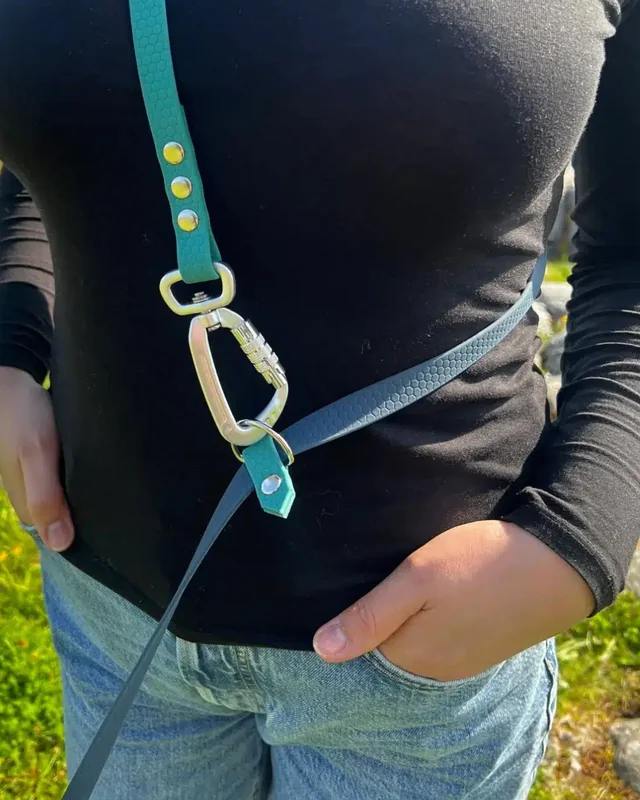
Hands-Free Dog Lead
from NOK 399.00
Hands-free dog lead in waterproof material, worn around the waist or over the shoulder. Available in 10 mm, 16 mm and 25 mm widths. Ideal as a running belt for jogging, hiking…
View product and customise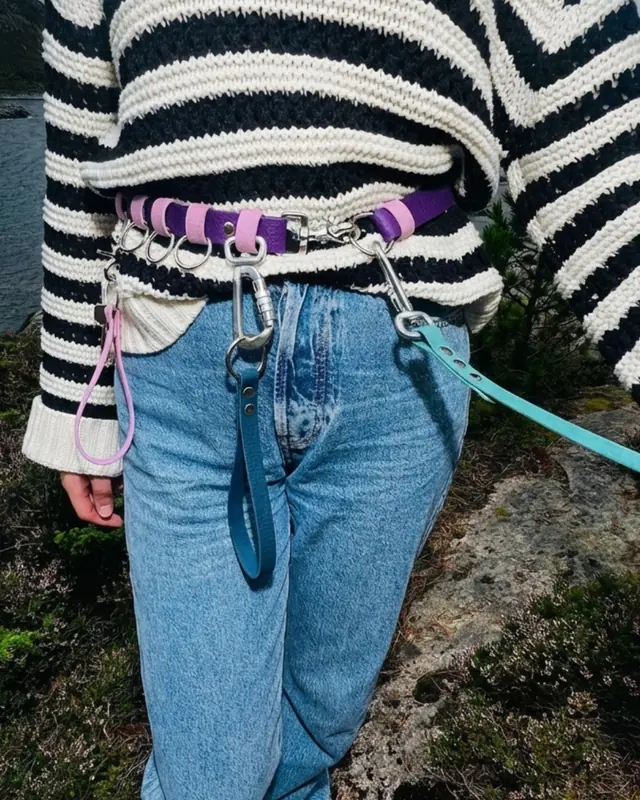

Belts
Adjustable Multifunctional Belt
from NOK 449.00
Adjustable dog walking belt in 16 mm or 25 mm waterproof webbing, designed for hands-free walks and dog sports. Fits sizes S to XL. Attach the lead to the belt and keep…
View product and customise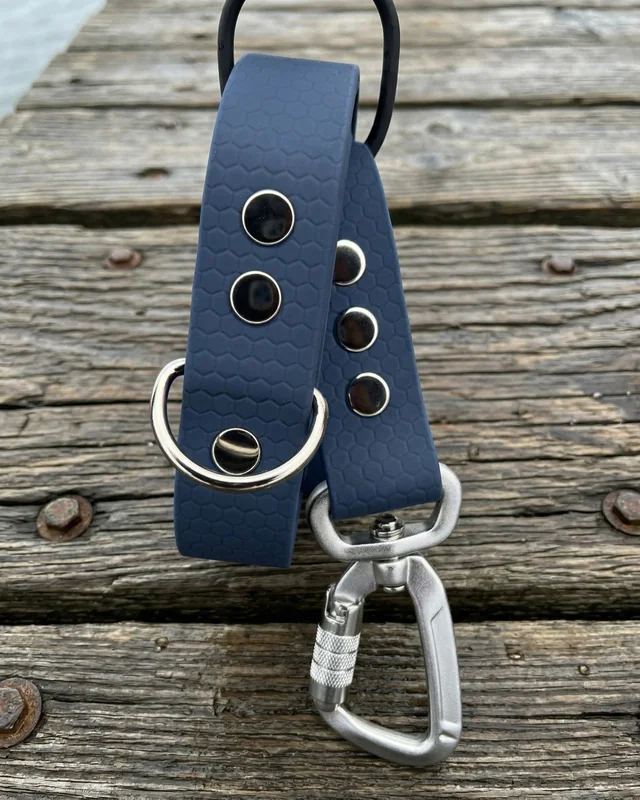

Dog leads
Classic Dog Lead
from NOK 329.00
Handmade dog lead in waterproof material with a honeycomb pattern for grip. Choose between three widths and lengths from 1.2 to 5 metres. Handles all kinds of weather, mud and…
View product and customiseChoose the right width
Width is about more than appearance.
10 mm suits small and medium-sized dogs — light, discreet and unobtrusive against your hips when running. 16 mm is the standard choice for most: good strength, suitable for dogs from 8 to 35 kilos. 25 mm is for large, powerful dogs such as Bernese Mountain Dogs or Malamutes, where you want to spread the pull over a wider area.
Unsure? Choose 16 mm. It suits 80% of situations.
How to use your hands-free lead correctly — the most common mistakes
We see three mistakes again and again with new users.
The first: the lead sits too high. Around the waist (where your trousers sit) is the wrong position. It should sit around your hips — over the hip bones. That is where you are most stable, and where your body handles the dog's pull best.
The second: the lead is too long. Your dog should walk right beside you, not 50 cm ahead. Adjust the length so that your dog's shoulder is level with your hip.
The third — and most dangerous: a poor snap hook. A cheap hook can open if your dog pulls hard enough. Always use a locking carabiner (screw-lock hook) that cannot open accidentally. ÅlesHund uses matt-black alpine-style carabiners. They do not open by themselves.
Lead + belt — the best combination
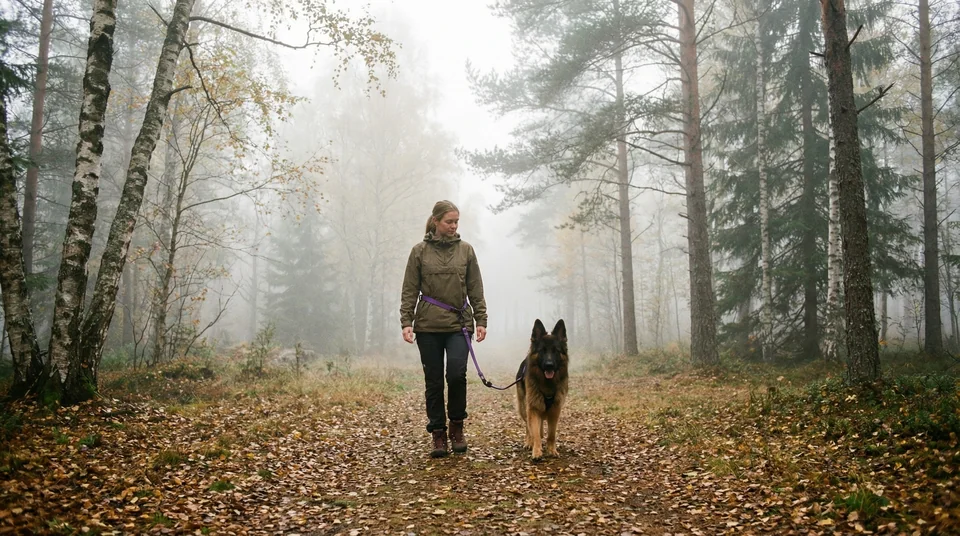
Many people combine a hands-free lead with a dedicated running belt. The belt holds the lead's belt section in place at speed, distributes pressure better, and prevents everything sliding down.
ÅlesHund's adjustable multifunctional belt uses the same waterproof material as the lead. You can adjust the belt and lead separately, giving you complete control over length and position.
This arrangement — belt + lead — is what many joggers and walkers settle on after some trial and error. It holds, it is comfortable, and it looks tidy.
A waterproof hands-free lead — what does that actually mean?
A “waterproof hands-free lead” does not mean the lead is designed for swimming. It means the material does not absorb water. It dries quickly after rain, does not stiffen in the cold, and does not smell of mud after a muddy walk.
The honeycomb pattern on ÅlesHund's leads also provides good grip. If you need to intervene and take hold manually — for example in traffic — it does not slip out of your hands.
Colours: hot pink, purple, lavender, teal and light pink. Your chosen colour does not affect function, but hot pink is surprisingly visible in the dark — a bonus if you are out after dusk.
Which dogs are hands-free leads suitable for?
Hands-free leads work for most dogs, but there are a few things to consider.
Pulling breeds — Huskies, Malamutes, Bernese Mountain Dogs — are natural partners for hands-free leads. They are used to working closely with their owner. Use a harness, not a collar, as constant pressure creates too much pulling force on the neck.
Active dogs that dart back and forth may need some training. A hands-free lead requires your dog to accept walking beside you, rather than ahead. It is not difficult to teach, but takes a few walks.
Older dogs and dogs with joint problems benefit from you relaxing more as you walk — something a hands-free lead often encourages, since you are not constantly braced with a lead in your hand.
Very young puppies should not use hands-free leads — they are too unpredictable. Wait until your dog is at least 6–8 months old and has learnt basic obedience.