Guides
Waterproof dog leads, collars and hands-free leads — the guide to Norwegian weather
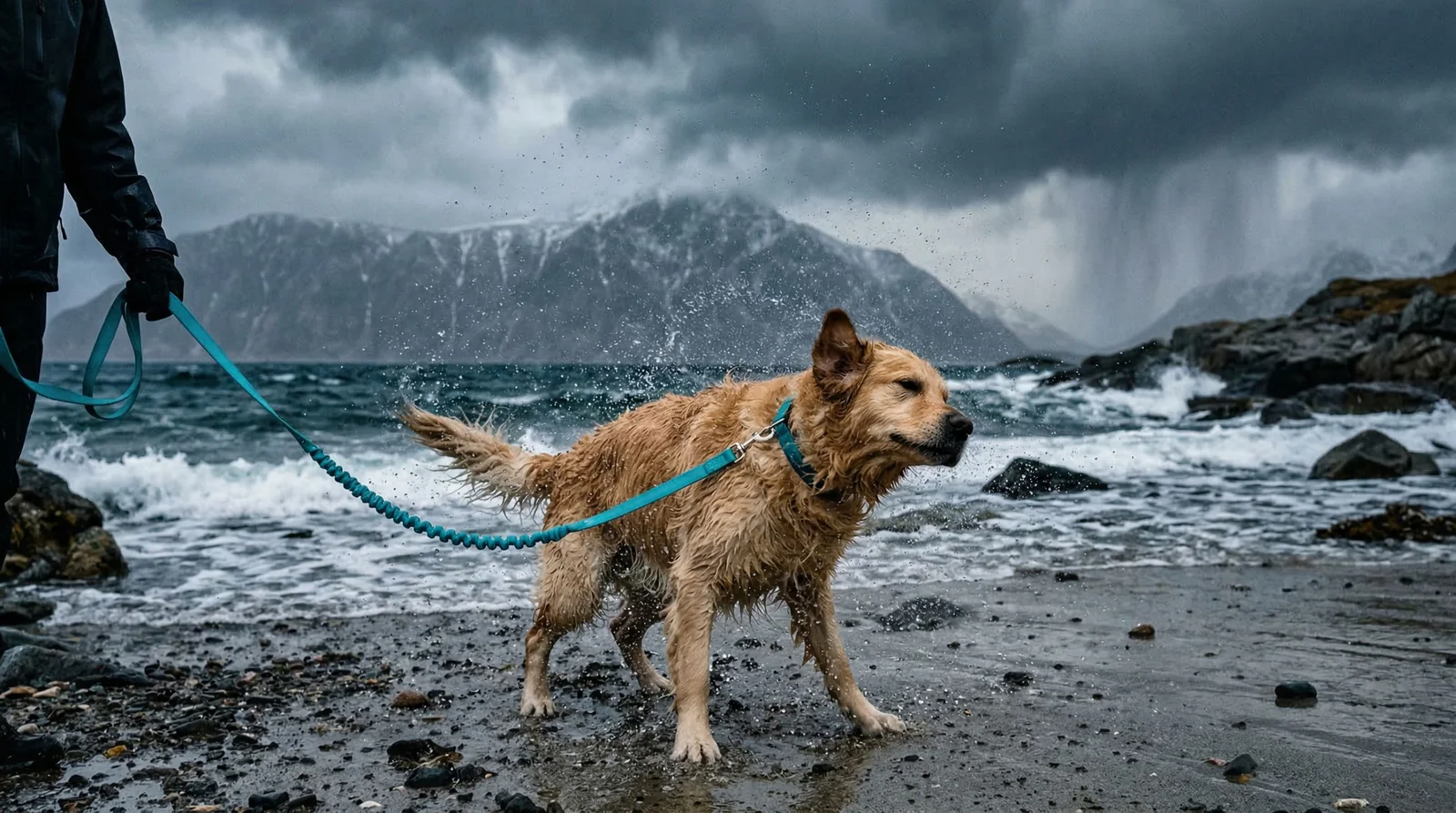
Let us be honest: Norway is no place for delicate dog leads. I live in Sunnmøre, where it rains on an average of 200 days a year. That is not an exaggeration — the Norwegian Meteorological Institute has the figures. The remaining days alternate between sleet, fog and the four summer weeks we pretend last longer than they do.
If you are looking for specific cleaning and care tips, we have a separate guide to dog leads that withstand rain and mud.
The point is that your dog equipment takes a beating. Every day, almost all year round. And it shows — in the smell, the colour, and how long the lead, collar or hands-free lead actually lasts before you need a replacement.
When I got my first dog fifteen years ago, I started with a perfectly ordinary nylon lead from the pet shop. NOK 149. It worked well for the first few weeks. But after an autumn of daily walks along the sea, it started to smell. Not a little — a lot. The sort of smell that settles into your coat pocket and refuses to go away.
After that, I tried leather. More attractive, more expensive, and it felt sturdy. But leather and the rain of western Norway are a poor combination. After two winters, the lead was stiff and starting to crack at the edges. I regularly applied leather conditioner, but it only helped temporarily.
Eventually, I switched to a waterproof dog lead — and later to a collar and hands-free lead in the same material. It changed everyday life with my dog more than I had thought dog equipment could. This guide explains what waterproof actually means, which pieces of equipment are worth replacing first, and how to recognise genuine quality.
What actually happens to ordinary dog leads, collars and hands-free leads in Norwegian weather?
Most dog products are made to look attractive in the shop. The problem starts when you actually use them outdoors, day after day, in a climate that gives you no break.
Nylon is the most common material. It is cheap and lightweight, and comes in every colour. But nylon is a woven textile. It absorbs water like a sponge. After a walk in the rain, you have a wet lead that takes hours to dry. Meanwhile, bacteria and mould develop — and that is the smell you notice. Many people machine-wash nylon leads, but it only helps for a while. The fabric's structure retains moisture regardless.
The collar fares even worse. It sits directly against the coat, often in an area the dog cannot reach itself. A wet nylon collar against the skin all day can cause rubbing, eczema and lasting coat discolouration. White fur around the neck turns yellow-brown. Pale coats develop a grey ring that will not wash out.
Leather is a better option in a dry climate. In Norway? Not quite as good. Leather needs maintenance, and cannot withstand getting soaked again and again without drying properly in between. The fibres break down over time. You end up with a lead that is stiff, cracked and has lost its lovely colour. Good leather can last a long time in southern Europe. In Bergen, Ålesund or Trondheim, its lifespan is shorter.
Rope and cord are popular with people who enjoy the outdoors. They withstand water better than nylon, but still absorb moisture. And rope dries slowly. Have you ever draped a wet rope lead over a chair and forgotten it for two days? Then you know what I mean. Rope is also difficult to clean when muddy — the fibres trap dirt and hold on to it.
Hands-free leads — arrangements that fasten around your waist — face an extra challenge. The belt section rests against your outdoor clothing, often for hours at a time. A wet, smelly belt means you still smell of dog long after you get home. It is one reason many people give up on going hands-free after a couple of months.
Our waterproof material — what actually is it?
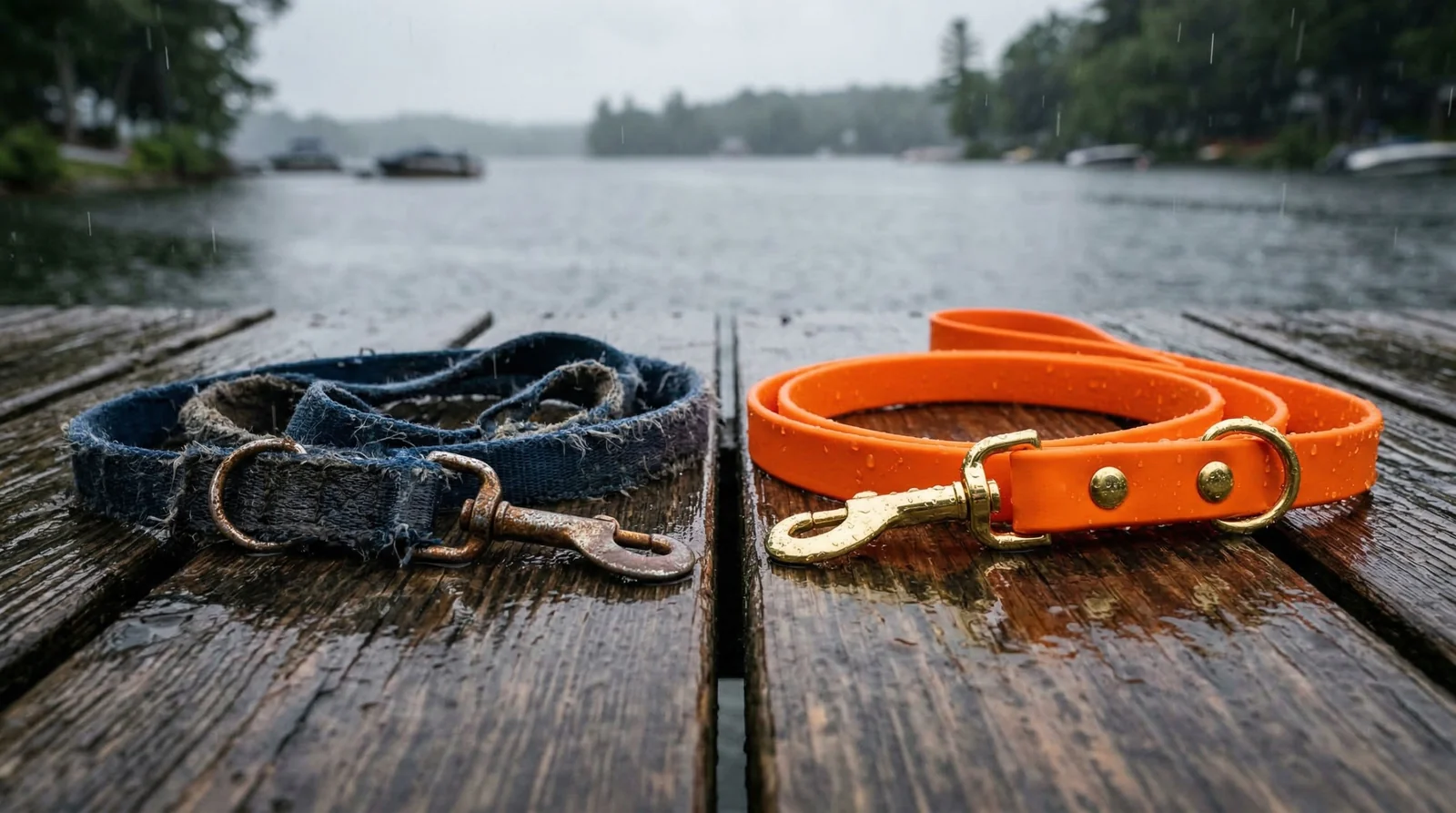
At ÅlesHund, we use TPU-coated polyester webbing for all our waterproof dog leads, collars and hands-free leads. In practice, this means the water simply runs off. It is not water-repellent — it is waterproof. The difference matters.
Water-repellent materials have an outer coating that makes water bead for a while, until the coating wears off. After a few months of daily use, the treatment has gone, leaving you with an ordinary piece of fabric that absorbs moisture. Waterproof means the material is sealed throughout its cross-section. It is not a surface treatment — it is the structure of the strap itself.
Here is an honest comparison based on several years of daily use in the Norwegian climate:
Weight: A waterproof dog lead weighs about the same as nylon. Noticeably less than leather. A 2.5-metre waterproof line weighs around 120 grams. The leather version of the same length weighed over 200.
Drying time: Waterproof TPU does not need to dry. You wipe it with a cloth, or leave it as it is. Nylon needs 6-12 hours indoors to dry properly. Leather takes even longer, and should not be hung on hot things such as radiators.
Smell: Waterproof products have no smell. Even after months of daily use in rain, seawater and mud. My nylon lead began to smell after two or three weeks of autumn rain. Leather developed a sour, musty smell after the first winter.
Strength: The material is surprisingly strong for its thickness. A 19 mm TPU-coated strap withstands a load of more than 400 kg — more than enough even for the largest dog breeds. It does not fray or wear at the edges the way nylon does.
Grip: Wet nylon is slippery. Have you ever tried holding back a 30-kilo dog with a wet nylon lead? Not fun. Our waterproof material retains its grip even when soaking wet. Not as soft as dry leather, but much better than wet nylon when it really matters.
Appearance over time: Nylon fades in the sun and turns greyish. Leather develops a patina — some people like it, others do not. TPU-coated material holds its colour. My dark-green lead looks much the same as when I bought it two years ago.
There is one area where leather wins: the feel. A good leather lead has a warmth and softness that synthetic materials cannot match. If you live somewhere with little rainfall and like the classic style, leather is still a lovely choice. But for Norwegian conditions, waterproof is simply more practical.
A waterproof dog lead — the right choice for daily walks
The dog lead is what you use most. Every walk, every day, all year round. It is also what gets dirtiest: mud from the trail, seawater from the shore, urine from other dogs marking lamp posts. A waterproof dog lead that withstands water means you do not have to give it all a second thought.
The most important things when choosing a waterproof lead:
- Length: 1.5–2 metres for urban walks and traffic. 3 metres for woodland walks. 5–10 metres for training walks in open areas. Most people manage well with one 2-metre lead for daily use and a longer training line as well.
- Width: 19 mm suits medium-sized to large dogs (15+ kg). 13 mm is adequate for smaller breeds. For very large, strong dogs, 25 mm may be safer.
- Snap hook: Stainless steel or solid brass. A screw-lock snap hook provides extra security if your dog is an escape artist.
- Handle: A good handle should feel comfortable even when the dog pulls suddenly. Check that it is neither too hard nor too thin.
For daily use, ÅlesHund's Classic Dog Lead is where I would start. It is simple, durable, and comes in several lengths and colours. Easy to clean, stays soft in the cold, and weighs next to nothing in your hand. We make each lead by hand in Ålesund, and every seam passes a quality check before it is sent out.
If you need extra control at close range — for example near traffic or when meeting other dogs — there is also a short waterproof handle that can be attached to the lead to take hold of your dog quickly.
A waterproof collar — comfort that does not rust or smell
The collar is the product your dog wears longest. Many dogs wear it around the clock. That makes the choice of material even more important here than for the lead.
A wet nylon collar against the neck for 12 hours creates a damp environment where bacteria thrive. Over time, this causes itching, skin irritation and coat problems. We regularly hear from customers whose dogs struggled with eczema for months — until they switched to a waterproof collar and the problem cleared up by itself.
Waterproof dog collars have three major advantages over nylon and leather:
- Hygienic: The material does not absorb moisture, urine or saliva. You can wipe the collar clean in ten seconds.
- No smell: The most important point for those whose dog joins them on the sofa. A collar that does not smell means your dog does not smell of collar.
- Holds its colour: Light collars stay light. Dark ones stay dark. No fading or discolouration of the coat.
At ÅlesHund, we offer two waterproof collars: the Buckle Collar for traditional adjustment, and the Clip Collar for quick fastening and removal. The buckle version allows more precise adjustment. The clip version is quicker to use if you remove the collar often — for example when your dog swims or gets into the car.
The right size matters. The collar should fit so that you can place two fingers between it and your dog's neck — no looser and no tighter. For puppies and young dogs, you need to adjust it frequently as they grow. Check the size every other week during growth periods.
A waterproof hands-free lead — hands-free freedom in every kind of weather
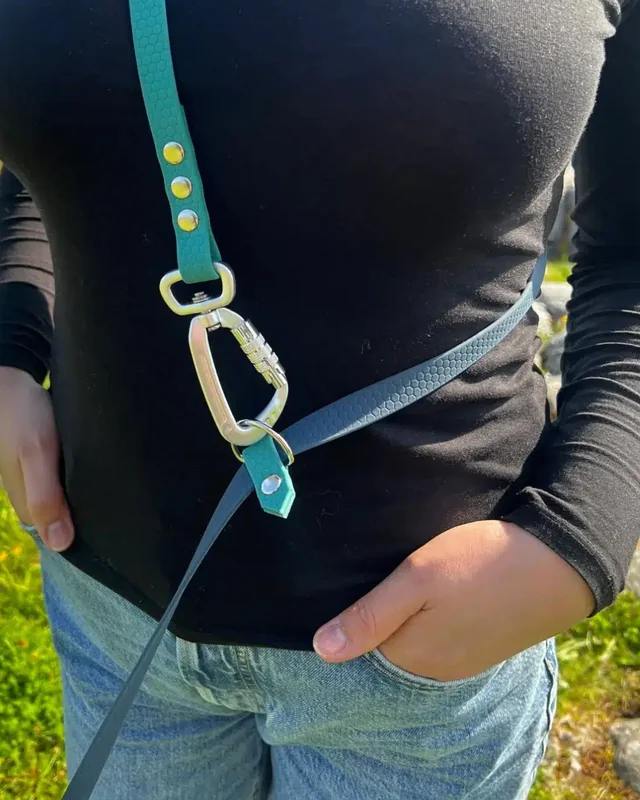
A waterproof hands-free lead is a solution for running, pushing a pram, cycling with your dog, or simply keeping your hands free on long walks. Unlike an ordinary dog lead, it fastens around your waist with an adjustable belt — the lead then runs from the belt to your dog through a shock absorber.
In the Norwegian climate, the material matters even more here than with an ordinary lead. The belt section rests against your jacket or trousers for hours. A wet, smelly belt means you start smelling of dog yourself. For many, that is enough to abandon the hands-free idea altogether.
Our Waterproof Hands-Free Lead solves this. The entire construction, both belt and lead, uses the same TPU-coated material as our other products. You can run in the rain for two hours, then rinse the lead under the tap when you get home. Done.
Active dog owners may also want to look at the Adjustable Multifunctional Belt. It can be used both as a traditional belt and as an extra attachment point for equipment on longer walks.
A few practical tips for using a hands-free lead:
- The belt should sit snugly around your waist, not your hips. This distributes the load correctly if your dog pulls.
- A shock absorber is important if your dog is large or tends to stop suddenly. It protects both your back and knees.
- Test the lead at home first, rather than on your first run. Your dog needs to get used to the handler moving without physically holding the lead.
Our waterproof bestsellers — made for Norwegian weather

Dog leads
Hands-Free Dog Lead
from NOK 399.00
Hands-free dog lead in waterproof material, worn around the waist or over the shoulder. Available in 10 mm, 16 mm and 25 mm widths. Ideal as a running belt for jogging, hiking…
View product and customise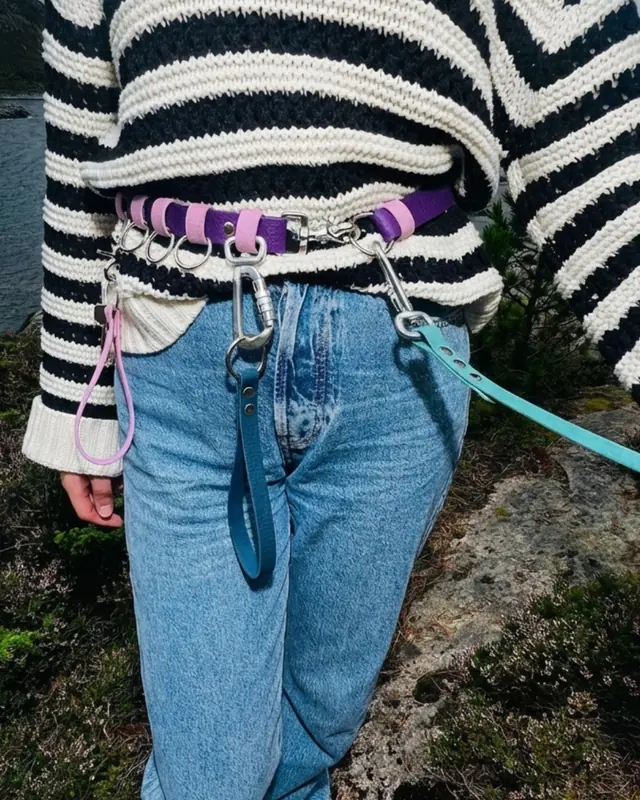

Belts
Adjustable Multifunctional Belt
from NOK 449.00
Adjustable dog walking belt in 16 mm or 25 mm waterproof webbing, designed for hands-free walks and dog sports. Fits sizes S to XL. Attach the lead to the belt and keep…
View product and customise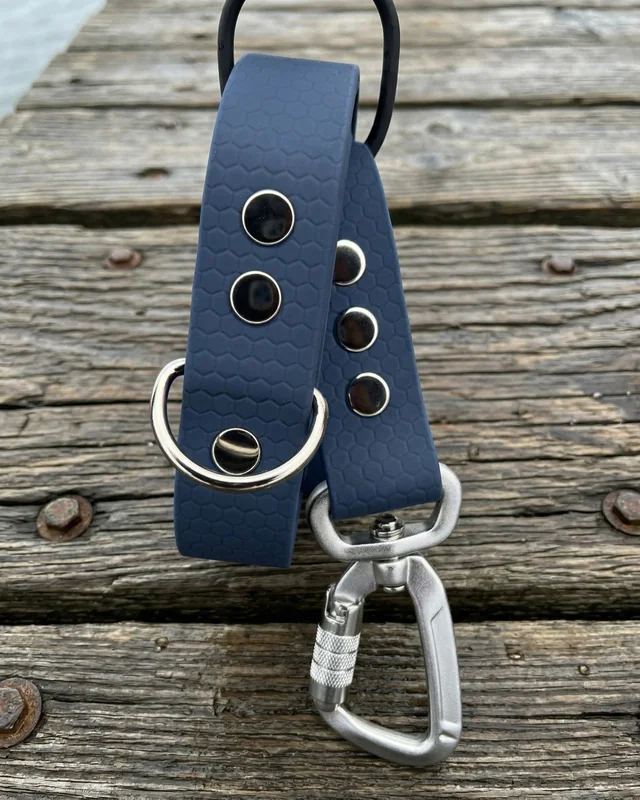

Dog leads
Classic Dog Lead
from NOK 329.00
Handmade dog lead in waterproof material with a honeycomb pattern for grip. Choose between three widths and lengths from 1.2 to 5 metres. Handles all kinds of weather, mud and…
View product and customiseHow to recognise genuine waterproof quality
Not everything sold as a “waterproof dog lead” is actually waterproof. Some manufacturers spray nylon with a water-repellent coating and call it waterproof. It may last a few weeks, but the coating wears off and you are left with an ordinary nylon lead.
Here is what I look for:
The material should be waterproof throughout. TPU-coated polyester or PVC-coated synthetic materials are waterproof all the way through, not just on the surface. Check the product description — “water-repellent” is not the same thing.
The seams matter. A waterproof material with poor seams lets water in along the edges. Good manufacturers use welding, rivets, or very tight, sealed stitching. Feel free to ask how the manufacturer handles the edges.
The hardware must withstand water. Stainless steel or solid brass is what you want. Cheap zinc-alloy hardware rusts. I have seen dog leads where the material itself was perfect after a year, but the snap hook was completely corroded and impossible to open.
Check where it is made. Handmade products from smaller workshops often have better quality control than mass-produced goods. That shows in how long the product actually lasts.
A tip: do the water test at home. Put the lead, collar or hands-free lead in a bucket of water for ten minutes. Wipe it with a towel. If it weighs the same as before — congratulations, it is waterproof. If it has absorbed water, it is not.
Maintenance — or the lack of it
Here is the part I like best about waterproof dog products: there is almost nothing to do.
After a muddy walk, I rinse the lead, collar and hands-free lead under the tap. Done. Sometimes I wipe them with a cloth. That is the entire maintenance routine.
Compare that with leather, which needs regular conditioning, should dry slowly, and must never be placed in direct heat. Or nylon, which should be machine-washed regularly and still eventually starts to smell.
A few tips to keep waterproof products in good condition for years:
- Rinse off salt after walks by the sea. Salt does not harm the material, but can dull the hardware over time.
- Check the snap hook regularly. The lead itself lasts a long time, but moving parts wear.
- Do not put the lead in the tumble dryer. It does not need it, and high heat can affect the TPU layer.
- In freezing temperatures, residual water can freeze in the seams. This is harmless, but let the lead thaw somewhere warm before the next walk.
- For the collar: take it off once a week and check the skin underneath. Even with waterproof material, this is a good routine.
That is it. I spend perhaps 30 seconds on maintenance per walk. With the leather lead, I spent 15 minutes every other week.
Comparison: waterproof vs nylon vs leather
To make choosing easier, here is a brief overview of how the three most common materials compare in the Norwegian climate:
Water resistance:
Waterproof (TPU): sealed throughout its cross-section; water runs off
Nylon: absorbs moisture like a sponge; needs a long drying time
Leather: tolerates a little moisture; damaged by repeated soaking
Expected lifespan with daily use:
Waterproof: 5+ years with proper care
Nylon: 1–2 years before smell and wear require a replacement
Leather: 2–4 years, less in a damp climate
Weight:
Waterproof (2.5 m): approx. 120 g
Nylon (2.5 m): approx. 130 g
Leather (2.5 m): approx. 220 g
Smell:
Waterproof: none
Nylon: develops within weeks in a damp climate
Leather: musty smell after the first winter
Price:
Waterproof (quality): NOK 350–600
Nylon: NOK 100–250
Leather (quality): NOK 400–800
Cost per year of use:
Waterproof: NOK 70–120/year
Nylon: NOK 100–200/year (including replacements)
Leather: NOK 150–300/year
The calculation over time is what really sets them apart. A waterproof lead costs more in the shop, but lasts so much longer that it becomes cheaper per year than nylon. And you avoid the irritation.
Frequently asked questions about waterproof dog products
Can waterproof dog leads withstand the cold?
Yes. TPU-coated polyester stays soft and flexible well below minus twenty degrees. We use the products ourselves in Ålesund all winter without problems. Leather becomes hard and prone to cracking in the cold — that is a different story.
Can my dog swim while wearing a waterproof collar?
Absolutely. The material withstands both fresh water and salt water. Just rinse the collar after a swim in the sea to keep the hardware looking good for longer.
How long does a waterproof hands-free lead last compared with a nylon version?
Our waterproof hands-free lead normally lasts 5–7 years with daily use. An equivalent nylon lead usually starts to smell and wear around the belt after 1–2 seasons.
Can synthetic materials cause allergies in dogs?
TPU-coated polyester is not known to cause allergic reactions. In fact, the opposite applies — because the material does not retain moisture and bacteria, there are fewer skin reactions than with nylon or leather.
Can I machine-wash waterproof dog leads?
You do not really need to — a quick rinse under the tap is enough. But if you want to, the material withstands a gentle machine wash at 30 degrees without soap. Do not tumble-dry.
What is the difference between waterproof and water-repellent?
Waterproof means the material is sealed throughout its cross-section — water cannot get in. Water-repellent is a surface treatment that makes water bead for a while, but wears off. Buy waterproof, and it stays that way. Buy water-repellent, and you have it for a few months.
Are waterproof products suitable for large dog breeds?
Yes. The width of material (19 or 25 mm) withstands a load of more than 400 kg — enough for the largest dogs. Check the collar size and lead width, and you are safe.
Summary
A waterproof dog lead, collar or hands-free lead costs more than nylon alternatives from the discount shop. That is a fact. But the calculation over time looks different. I replaced nylon leads twice a year because they smelled or were worn out. My leather lead lasted a year and a half. The waterproof equipment I bought more than two years ago still looks good and has no smell.
In a country where it rains more often than not, choosing waterproof dog equipment makes sense. It is not about luxury. It is about avoiding the irritation of a wet, smelly lead on every single walk from October to April.
Your dog deserves good walks. You deserve dog equipment that Norwegian weather will not ruin in a few months. Waterproof solves both — whether you start with the lead, collar or hands-free lead.
Want to see the full range? Explore our waterproof dog products — all handmade in Ålesund.