Guides
Dog lead materials: how leather, nylon, rope and waterproof webbing differ
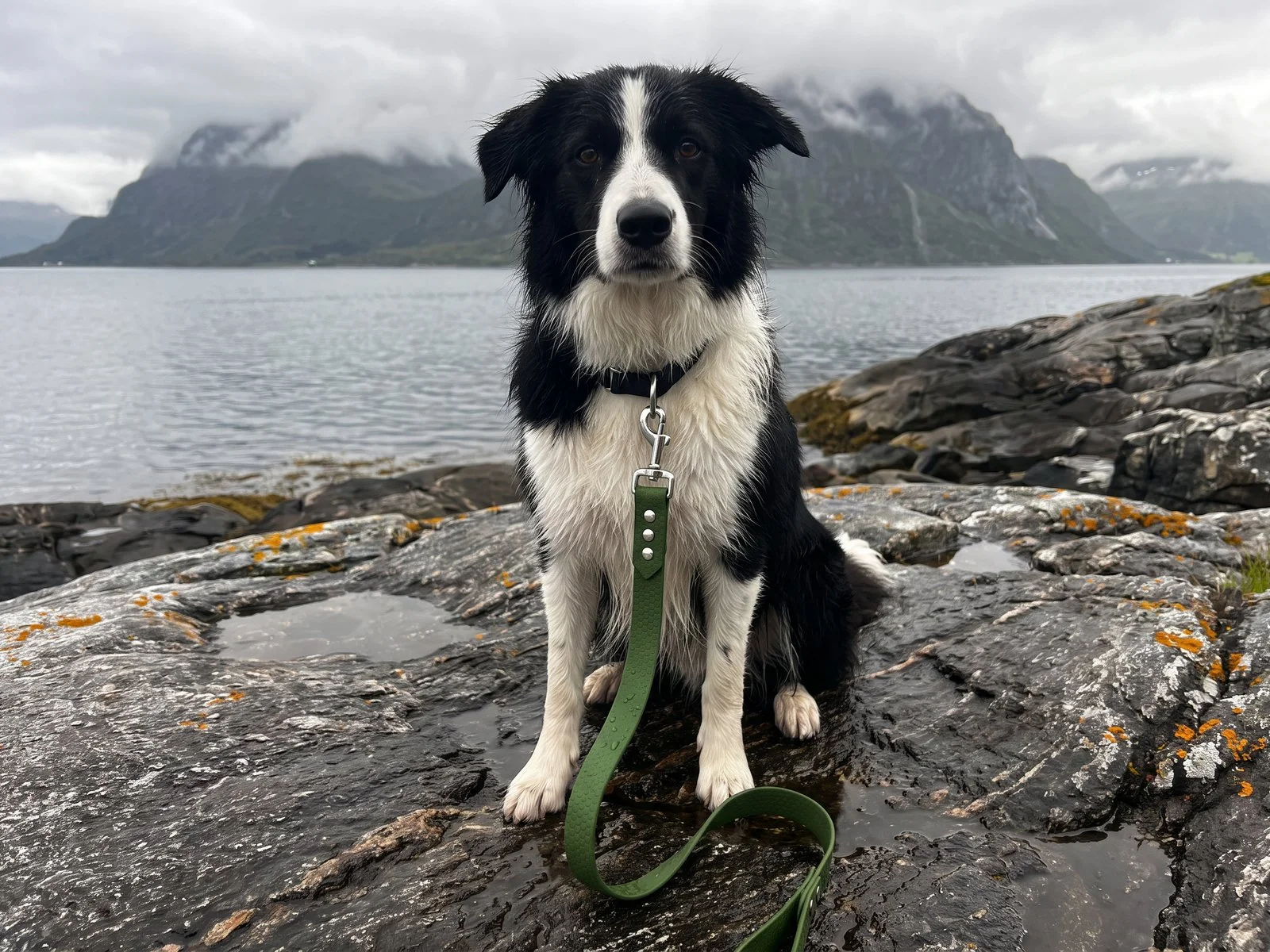
Dog leads look fairly similar in an online shop. You notice the difference between dog lead materials after the first autumn by the sea. Then the lead is wet, cold and full of sand, and it needs to be clean and dry again before the next walk. We examine the materials one by one: leather, nylon, rope, chain and coated webbing. For each, we look at what happens in rain, saltwater, frost and mud, and how much care it needs. Then we show what we use ourselves and what laboratory tests on that material found. Where we do not have figures, we say so.
What a dog lead needs to withstand in Norwegian weather
A dog lead in Norway faces several kinds of wear during a year, which we divide into four groups. First is water, whether western Norway's rain or a dip in the sea. Then come road salt and saltwater in winter, followed by cold and frost, and finally mud working into stitching and between fibres. How a material handles these four factors says a great deal about how long a lead lasts. Here we look at the materials behind the lead and what distinguishes them.
Leather
Leather is the classic choice, and many people simply like its appearance. Through a Norwegian winter, it is also the material that needs the most attention.
Leather in water and salt
Oils and fats are often added to leather during tanning to make it supple and flexible. If leather repeatedly gets wet and dries, soluble substances can wash out and the fibres become damaged, making it stiffer and increasing wear. Washing also removes oils from leather. Chrome-tanned leather withstands moisture better than vegetable-tanned leather, which can shrink or stiffen when wet. Winter brings road salt too. Rinse off saltwater and road salt with fresh water, and allow the leather to dry at room temperature.
Caring for leather leads
A wet leather lead dries best at room temperature, well away from heaters and other strong heat sources. Heat can make leather brittle and cause it to warp. For leather in daily use, the University of Florida recommends moderate amounts of leather conditioner; applying it when the lead is dry keeps it soft.
Nylon and polyester as woven webbing
Nylon and polyester are two different fibres, and the difference is most noticeable when a lead gets wet. Nylon fibre can absorb between 2 and 6 per cent water, while polyester absorbs less than one per cent. Wet nylon retains around 85 to 90 per cent of its dry strength, a reduction of 10 to 15 per cent. Polyester is equally strong wet and dry. Nylon also gives more than polyester, meaning it stretches more under load. In our experience, woven leads draw water between their threads and therefore take longer to dry than a smooth, coated surface.
Polyester therefore makes a good core to build on, provided it has a coating that keeps water out. We look more closely at that combination under coated webbing below.
Rope made from paracord, cotton and polypropylene
Rope is used for long lines and training lines, among other things, and how it behaves depends on what it is braided from. Genuine paracord is braided nylon and is designed to stretch to a certain extent under load. The American military specification MIL-C-5040H, now inactive, requires Type III to have a minimum breaking strength of 550 lb and at least 30 per cent elongation at break. Cotton rope absorbs a lot of moisture and dries slowly, and cotton has poor resistance to rot and mould, so leave it to dry in a well-ventilated place after a wet walk. Polypropylene rope floats and absorbs little water.
Chain, briefly
Chain is heavy and not very comfortable on long walks. We think chain is poorly suited to small dogs because a metal lead becomes heavy relative to the dog's weight. Some people nevertheless choose chain for dogs that chew their leads. It is a trade-off against weight and comfort, and we do not recommend it as the standard choice.
Coated webbing with PVC or TPU around a polyester core
Coated webbing is a category of its own. The core is woven, usually from polyester, and covered with a PVC or TPU coating. The core supplies the strength, and the coating keeps water out.
Several brands of this type of webbing are available. BioThane is a registered American trademark for coated webbing (USPTO registration 1559827). According to the manufacturer, its Beta range uses a PVC coating with a matt finish, while its Gold range uses a TPU coating with a glossy finish. PawTex is a registered EU trademark for coated webbing, owned by a Dutch company (EUIPO number 019173997). According to the manufacturer, PawTex is polyester webbing with a PVC coating and a smooth, matt surface without a pattern.
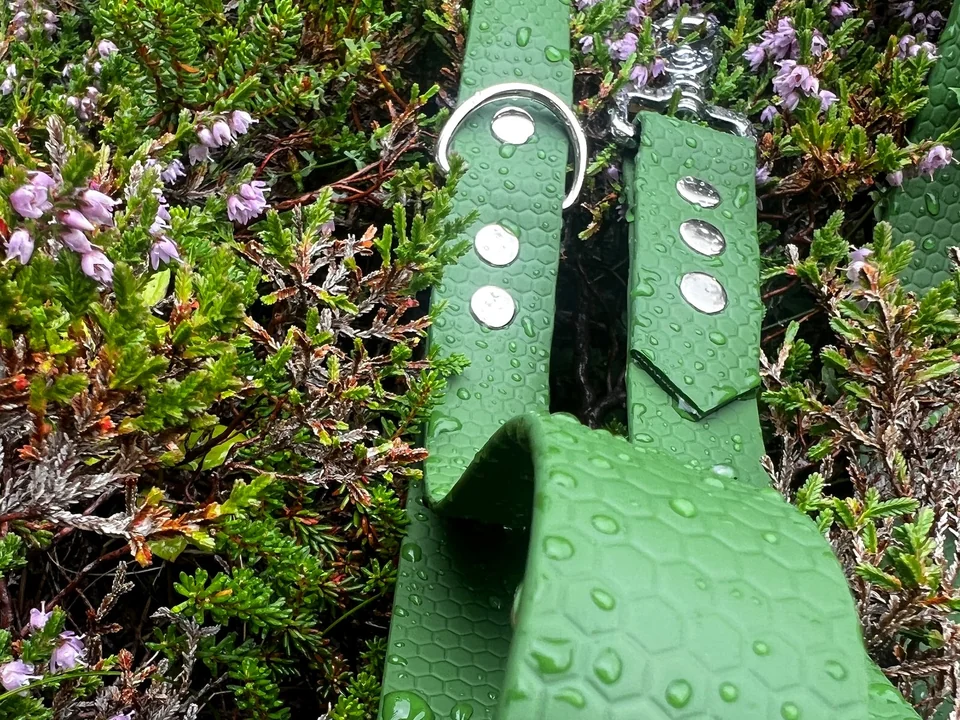
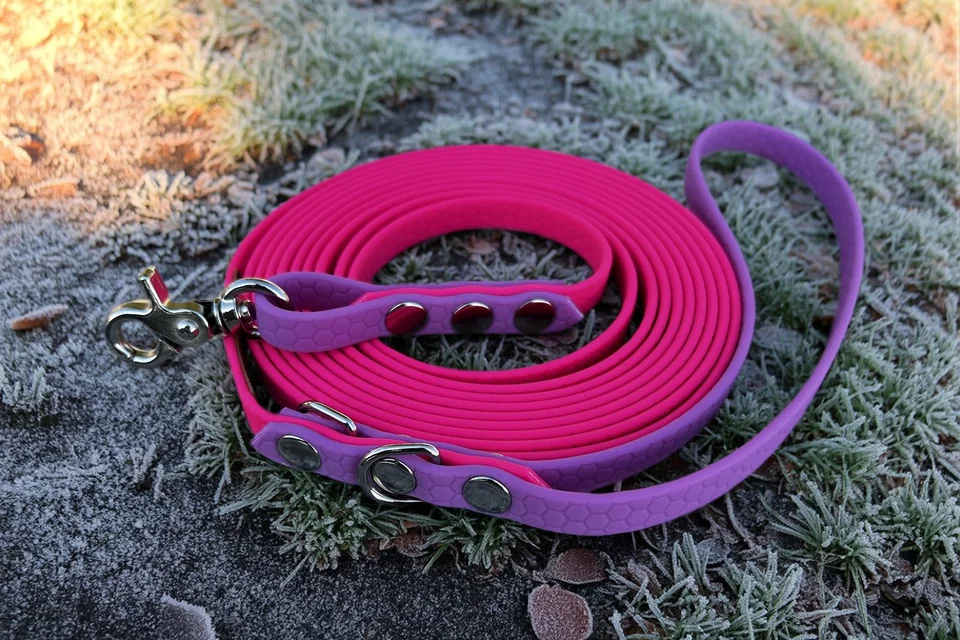
The webbing we sew is neither BioThane nor PawTex: it is polyester webbing with a PVC coating and a honeycomb pattern embossed on both sides. Some colour options in our range use another waterproof webbing without this pattern, and the breaking-strength figures below do not apply to that material.
Waterproof webbing with a honeycomb pattern: what we use
Construction
Our webbing has a woven polyester core with a PVC coating and a honeycomb pattern embossed on both sides. The pattern gives your hand something to grip. The webbing is approximately 2.6 mm thick. According to the supplier, 16 mm webbing weighs around 45 grams per metre, and 25 mm around 67 grams. The supplier states that the coating does not absorb water, so it is the surface you rinse and wipe dry. In our experience, woven leads instead hold water between the threads and take longer to dry.
What the laboratory measured
The webbing was tested at TZÚ Brno, protocol AZL 24/1230, which measured breaking strength using the strip method in ČSN EN ISO 13934-1, commissioned by our supplier. Across five samples, 16 mm webbing broke at an average of 3800 N, approximately 387 kg. For 25 mm, breaking occurred at 6300 N, approximately 642 kg, and for 10 mm at 2400 N, around 245 kg. Each width was tested in one colour. The figures apply to the webbing itself, measured before it is sewn and riveted into a finished lead. A finished dog lead is never stronger than its weakest point, whether that is a seam, rivet or hook. We discuss that weak link in more detail in snap hooks for dog leads.
The cold test
In a cold test at SGS, report GZMR260501690001, commissioned by our supplier, two samples of PVC-coated webbing — one with a honeycomb pattern — were held for four hours at temperatures down to −40°C, then bent through 180 degrees over a 3.8 mm mandrel. No visible cracks were found in either sample. The test shows how the material behaved under these conditions.
Seawater and salt
The supplier states that the webbing withstands regular contact with seawater. Nevertheless, rinse it in fresh water after your walk, particularly around stitching and hardware.
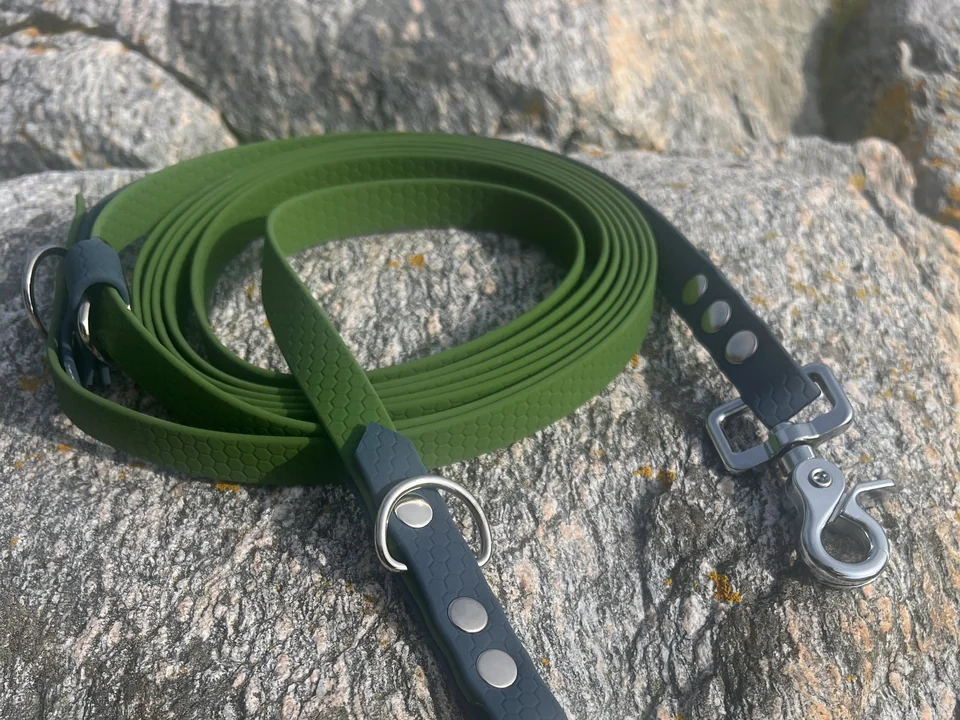
If you would like to try the material yourself, the Classic Dog Lead from NOK 329 is the starting point in our range.
Comparing materials
The table brings together the most important differences from the sections above.
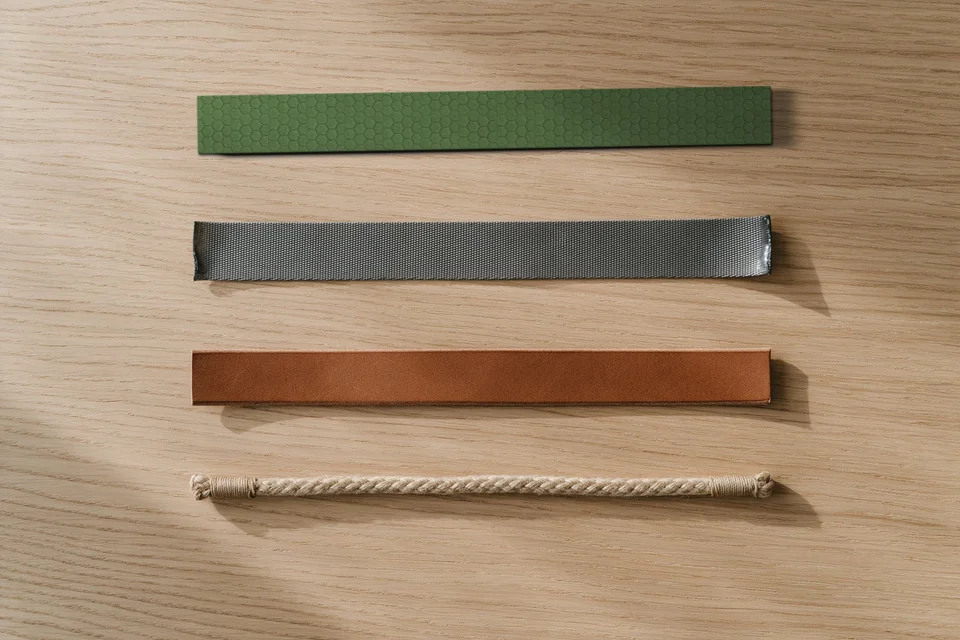
| Leather | Woven nylon | Rope | Waterproof webbing (ours) | BioThane | PawTex | |
|---|---|---|---|---|---|---|
| Construction | Tanned hide, chrome- or vegetable-tanned | Woven nylon fibre | Braided nylon (paracord), cotton or polypropylene | Polyester core with PVC coating | Polyester core with PVC (Beta) or TPU coating (Gold), according to the manufacturer | Polyester core with PVC coating, according to the manufacturer |
| Water absorption | Repeated moisture can wash substances out of the leather | Fibre absorbs 2 to 6%, with more between the threads | Cotton absorbs a lot, polypropylene very little | The coating does not absorb water, according to the supplier | The coating does not absorb water, according to the manufacturer | The coating does not absorb water, according to the manufacturer |
| Seawater and road salt | Rinse with fresh water and dry | Rinse and dry | Rinse and dry | Withstands seawater according to the supplier; rinse with fresh water after walks | – | – |
| Cold | – | Lower operating temperature approx. −57°C (USCG) | Nylon approx. −57°C, polypropylene approx. −29°C (USCG) | Tested (2 samples, 20 mm): 4 hours down to −40°C, bent 180°, no visible cracks | Flexible in cold according to the manufacturer; no temperature specified (Sept. 2026) | Cold-resistant according to the manufacturer; no temperature specified (Sept. 2026) |
| Care | Moderate amounts of leather conditioner; dry without heat | Wash, air-dry | Wash, air-dry (cotton needs the most ventilation) | Rinse; use a soft brush in the pattern | Soap and water, according to the manufacturer | – |
“–” means our sources lack data for that point. It says nothing about how well the material performs there. The breaking strength in the column for our webbing applies to the honeycomb-patterned version. The cold test included one patterned and one unpatterned sample. BioThane and PawTex are trademarks belonging to other manufacturers. Trademark ownership details come from USPTO and EUIPO. Other information about BioThane and PawTex comes from the manufacturers themselves (Sept. 2026).
Our waterproof bestsellers — made for Norwegian weather

Dog leads
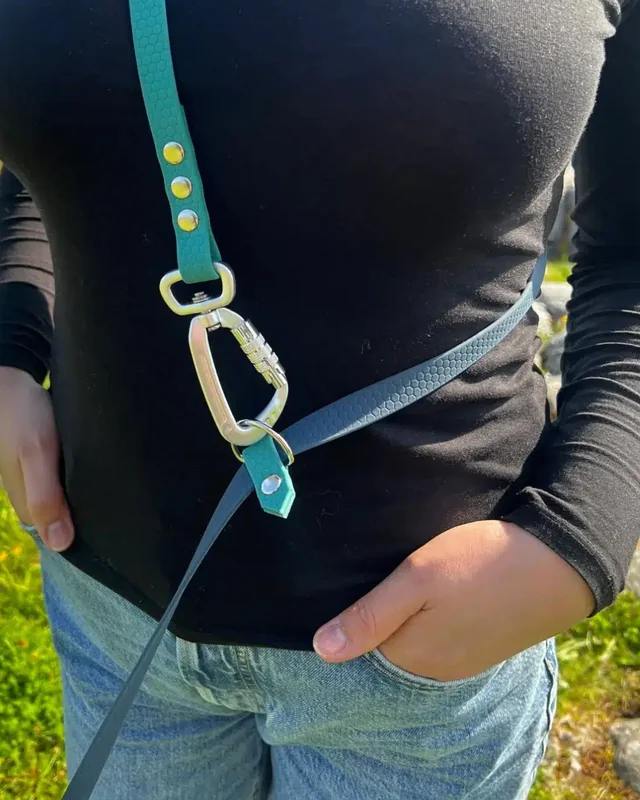
Hands-Free Dog Lead
from NOK 399.00
Hands-free dog lead in waterproof material, worn around the waist or over the shoulder. Available in 10 mm, 16 mm and 25 mm widths. Ideal as a running belt for jogging, hiking…
View product and customise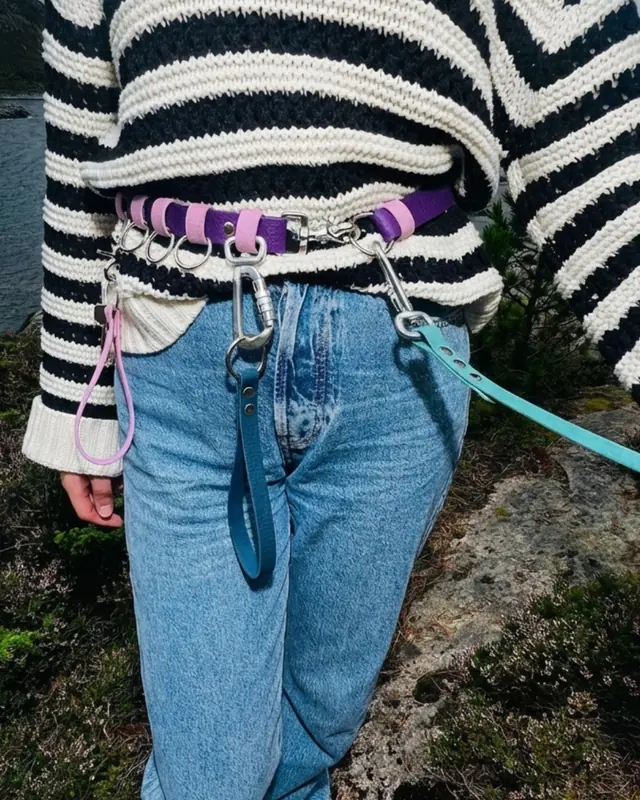

Belts
Adjustable Multifunctional Belt
from NOK 449.00
Adjustable dog walking belt in 16 mm or 25 mm waterproof webbing, designed for hands-free walks and dog sports. Fits sizes S to XL. Attach the lead to the belt and keep…
View product and customise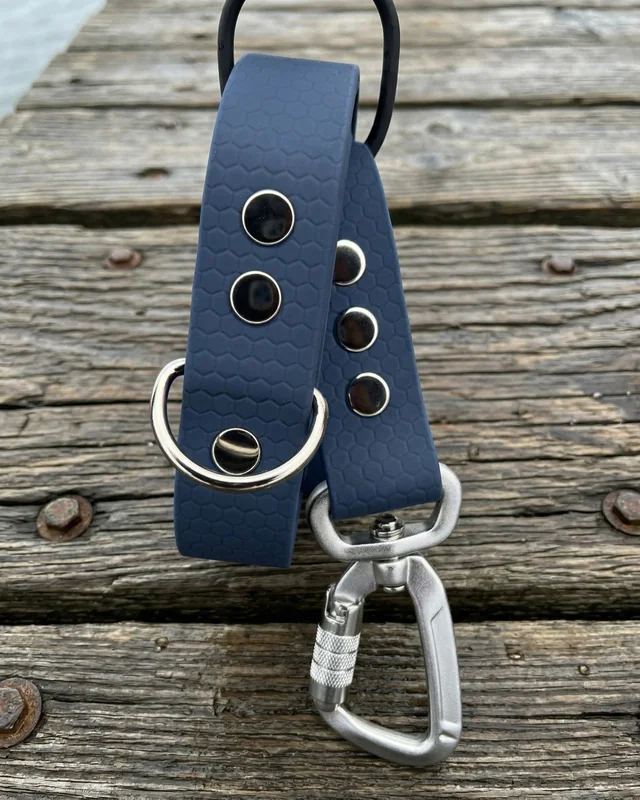

Dog leads
Classic Dog Lead
from NOK 329.00
Handmade dog lead in waterproof material with a honeycomb pattern for grip. Choose between three widths and lengths from 1.2 to 5 metres. Handles all kinds of weather, mud and…
View product and customiseCold and frost: what happens to the material
We have not found tests of finished leads in freezing conditions. For fibres, the U.S. Coast Guard gives a lower operating temperature of around −57°C for nylon and around −29°C for polypropylene. We have not found figures for leather. Our webbing has been cold-tested; see above. According to its manufacturer, BioThane remains flexible and durable in cold weather, and PawTex states that its webbing is cold-resistant. Neither manufacturer specifies a temperature (Sept. 2026), so we have no figures to compare here.
Caring for dog leads by material
Dry leather leads at room temperature and apply moderate amounts of leather conditioner once dry, as described above. Nylon or rope leads should be washed with soap and water and air-dried.
Rinse waterproof webbing in lukewarm water with mild soap. If soil remains in the honeycomb pattern, a soft brush is enough to remove it. DEET in insect repellent can damage plastic, vinyl and some synthetic materials, so keep the lead away from insect repellents containing DEET. Rinse and dry the snap hook and other metal parts after a walk by the sea too. We have put the full care routine after a muddy walk in dog leads that withstand rain and mud.
How to choose a material
Width should match your dog's size. 10 mm suits small dogs up to around 10 kg, 16 mm dogs between 10 and 35 kg, and 25 mm large dogs over 35 kg. These figures are our recommendation, not an absolute limit. We explain which length you need in dog lead length.
The rest depends on how the lead will be used. For short walks in town, a Classic Dog Lead of 1.2 to 2 metres is sufficient. For walks and hiking, 3 metres works well, or the Hands-free Lead. If you plan to jog with your dog, combining the lead with an adjustable multifunctional belt is a good starting point. We have also written a separate guide to dog running belts. For recall and tracking training, a long training line of 5 to 10 metres is more practical.
Then there is the climate. Along the coast, in rain and with road salt in winter, coated webbing is a practical choice requiring little care. In a dry inland climate and for smarter occasions, leather can work well, provided it receives the care described above.
We discuss what to look for when choosing a dog lead in best dog leads. Why we think waterproof equipment is worthwhile in Norway's climate is explained in waterproof dog leads.
The same waterproof webbing with a honeycomb pattern is also used in clip collars, buckle collars and accessories.
Frequently asked questions
Which dog lead material is best in rain?
Coated webbing, including our waterproof webbing with a honeycomb pattern, withstands rain well because the coating does not absorb water. Leather and woven nylon both need drying and care after a wet walk.
Are leather leads damaged by water and salt?
Repeated moisture can wash substances out of leather, making it stiffer over time. Drying the lead at room temperature and regularly applying moderate amounts of leather conditioner helps it last longer.
Does nylon absorb water?
Nylon fibre itself can absorb between 2 and 6 per cent water. In our experience, a woven lead also holds water between its threads. This is why nylon takes longer to dry than a smooth, coated surface. While wet, nylon retains around 85 to 90 per cent of its dry strength.
Is waterproof webbing the same as BioThane?
No. BioThane is a registered American trademark (USPTO registration 1559827), while PawTex is a registered EU trademark for coated webbing, owned by a Dutch company (EUIPO number 019173997). According to the manufacturers, both are polyester webbing with a PVC coating, and the American brand also has a TPU range. We sew another webbing with a polyester core, PVC coating and honeycomb pattern embossed on both sides. All three belong to the coated-webbing category, but they are different products from different manufacturers.
Does waterproof webbing withstand cold?
In a cold test at SGS, report GZMR260501690001, commissioned by our supplier, two samples of PVC-coated webbing were held for four hours at temperatures down to −40°C and then bent through 180 degrees. No visible cracks were found. The result applies to the conditions of this test.
How strong is a waterproof-webbing dog lead?
At TZÚ Brno, protocol AZL 24/1230 (ČSN EN ISO 13934-1), commissioned by our supplier, 16 mm webbing broke at an average of 3800 N, approximately 387 kg. For 25 mm, the breaking point was 6300 N, approximately 642 kg. These figures apply to the webbing itself, measured before stitching and riveting. A finished lead is never stronger than its seam, rivet or hook; read more about the weak link in snap hooks for dog leads.
Which material is easiest to keep clean?
Rinse waterproof webbing in lukewarm water with mild soap, using a soft brush for anything left in the pattern. Dry leather at room temperature and apply moderate amounts of leather conditioner; nylon and rope should be washed and air-dried.
Which width should you choose for your dog?
As a starting point, we recommend 10 mm for small dogs up to around 10 kg and 16 mm for dogs between 10 and 35 kg. For large dogs over 35 kg, we recommend 25 mm. If you are unsure about the width, please contact us.
Why we choose waterproof webbing ourselves
When we assess dog lead materials, we focus mainly on how they handle water. Leather needs care and tolerates water poorly. Woven nylon holds water and can become weaker while wet. Cotton rope needs to dry properly to avoid mould, and chain is heavy. Coated webbing keeps water out, and we name the laboratory, method and report number for tests on the webbing we use.
All our leads, hands-free leads, belts and collars are sewn by hand in Ålesund, and most colours use the waterproof honeycomb-patterned webbing described above. Buy two or more products, such as the Hands-free Lead and Adjustable Multifunctional Belt, and 10% is deducted automatically at checkout. Delivery costs NOK 77 and is free from NOK 1099. If you would like to feel the material, the Classic Dog Lead from NOK 329 is a good place to start.
Sources
Below are the sources behind the figures and material claims in the article above.
Laboratory tests of our webbing
- TZÚ Brno, protocol AZL 24/1230 (ČSN EN ISO 13934-1)
- SGS, report GZMR260501690001
Leather
- Conserving objects made from leather and skin. NPS Museum Handbook, U.S. National Park Service
- Caring for leather, skin and fur. Canadian Conservation Institute (CCI)
- Care of alum-, vegetable- and mineral-tanned leather. CCI Notes 8/2, Canadian Conservation Institute
- Care of saddlery and leather equipment in hot, humid climates. AN303, University of Florida IFAS Extension
Fibre and rope
- Table 7-1 Fiber Line Characteristics, p. 7-3. Boat Crew Seamanship Manual (COMDTINST M16114.5C), U.S. Coast Guard
- Polyester — textiles. Store norske leksikon (SNL)
- Cotton. Store norske leksikon (SNL)
- Polypropylene. Store norske leksikon (SNL)
- Polypropylene — textiles. Store norske leksikon (SNL)
- Military specification for braided nylon cord (MIL-C-5040H). Archived by EverySpec, a free specification archive
Trademarks
- BioThane trademark registration (registration 1559827). USPTO, the United States trademark office
- PawTex trademark registration (number 019173997). EUIPO, the EU's official trademark register
Insect repellent
- DEET technical fact sheet. National Pesticide Information Center
- About DEET and insect repellents. Illinois Department of Public Health